Showing posts with label Fiction. Show all posts

Monday, February 17, 2025

THE MARRIAGE OF WILLIAM FAULKNER AND e.e. cummings

the Hack responded to the Melbourne Assessment through a TeamViewer portkey probing into the case of the missing emails, the mystery of the Monday meetings overlap, why the line to Kuala Lumpur is in Rio De Janeiro when a reallocation was approved to develop content for Jakarta with an OPA amendment as the aborted rumble in Phnom Penh was reenacted in a condensed appraisal report, the flight to Luang Prabang imperiled by an intense electronic exchange inscribed in a project charter and a memorandum about an MCP review on why the Phantom Biker was enrolled in both MSH International and Cigna Healthcare     

'twas pooping cat and dogs
and a vegetable medley wrapped in tripe
warm and airy, short and gamey like salt bread 
a delicate curtain of soft college rain


St. Peter's milkfish, dressed in mud then fried in bottles of extra strong lager, stood between two nights of pure libationism, a wall of bottled amber for the advance nights of a fatback on a crisp February evening, plated and skewered, as the pool filled up with exceptional blended Scotch whiskey to celebrate St. Valentine's abstinence in a week when a "prose of complex and unconventional sentence structure" was fused with "modernist free-form poetry"

a benediction, a warm morning feed, a wet market
a party of saints and kings at a Lakers ballpark

ripe fishwife carved  in a plump green plastic mesh
a homily, a bike wash, pickled tank goby


Tuesday, December 17, 2013

ANGELES OVERNIGHT

Halos isang oras ang biyahe mula Cubao hanggang SM-San Fernando, kasama na ang pagsakay sa mga pasahero ng isa pang bus na nawalan ng preno sa NLEX at sumundot sa puwet ng kapwa nito bus, na nadagdagan ng isa pang masalimuot na biyahe mula SM papuntang Angeles dahil sa nakababaliw na trapik sa may Marquee Mall, at halos isa pang oras mula sa binabaan ko ng dyip hanggang mahanap ng traysikel na parang-taxi-maningil-ng-pamasahe ang aking hotel kung saan naging tagapakinig ako sa hampas ng head board ng kama sa dingding mula sa kabilang kuwarto at naulinigan ang impit na ungol ng isang babae na hayaan lang na magsuntukan ang kama at dingding bago ako lumabas at naghapunan sa isang Greek Restaurant na katabi ng hotel.  


Kinaumagahan, muling nagpalabas ang kabilang kuwarto --- ang sarap sabi ng babae, huwag kang sumigaw sabi ng lalaki, wala akong pakialam ang sagot ng babae, dilaan daw sa itlog, puede daw sa puwet kapag matigas --- kaya muli akong lumabas ng kuwarto at nag-almusal ng mamantikang Australian breakfast at nagpahatid sa SM-San Fernando para sa biyahe pabalik ng Maynila.


Kagabi, may anghel na bumaba at sumamba sa kabilang kuwarto. Hindi ko lang alam kung may baon siyang pansit...
     

Saturday, September 07, 2013

THE LOST STORY OF FLORENTINO ARIZA AND FERMINA DAZA

The plan was hatched, revisited, pondered, and refined many times ever since Dr. Juvenal Urbino asked permission to see her father: Fermina Daza will foil her husband’s attempts to consummate their marriage until the day she only knew --- to be announced by a monthly cycle of a hot flushing feeling peculiar only to women, surrendering at the perfect moment when the blood inside her will start to curdle, which she successful did during their long honeymoon voyage to La Rochelle, her triumph etched in Dr. Juvenal Urbino’s concealed joy on seeing the red blot in the bed sheets as the ultimate proof that he alone took his wife’s chastity. 


But it was Florentino Ariza during one of those futile violin serenades under the balcony of her father’s house in La Manga, a desperate effort to win back the woman he loved and loved him before that fateful trip to Riohacha, when Fermina Daza, in an act of pity more than love, came down, took his hand to her virgin breasts, found themselves in a cold condemned hotel in a place named after a saint where her mouth taught Florentiza Ariza of a more intense pleasure than the final act of copulation, imprisoning him forever to that memory which haunted him to every willing womb he preyed on in an impossible quest to relieve that most blissful moment of his life, even pretending that it was Rosalba who first fulfilled his manhood, searching for that sensual mouth in the sluggishness of Widow Nazaret, in the longevity of Ausencia Santander, the rancour of Sara Noriega, the fatal infidelity of Olimpia Zulueta, in the amorous contradictions of the widows Prudencia and Prudencia and Josefa, in Angeles Alfaro who was nearest to being loved, in the madness and voracity of Andrea Varon, in the pubescence of America Vicuna, and many other others whose faces he had forgotten but whose names are written on a list he keep as an act of vengeance on Fermina Daza. 


They have become one, fated to be apart but destined for each other, for their love at the time of cholera has infected their lives until the day when they will cruise the Magdalena River forever, a destiny preluded by Fermina Daza’s return to La Manga twenty years later to attend to the death of her husband’s mother where she discovered the resilience of that single night, for she shuddered with just knowing that Florentino Ariza still lives, while Florentino Ariza was thrown back into the lost love-struck lover he was many years ago when he learned of Fermrina Daza’s impending marriage to Dr. Juvenal Urbino, the triumph of his countless conquests vaporized by his helplessness, for the fragrance of Fermina Daza never left him since that night in the old hotel. 


Under the dire circumstance of a wake for a dead woman, their eyes met and they knew that they must be together again, their rekindled passion leading them to a newly built hostel with no name where they flung into each other like mortal enemies in combat, kissed like they want to swallow each other alive, Fermina Daza’s mouth doing its magic and Florentino Ariza trembling with insane sensuality like the night when he lost his virginity, the longing and hurting of the last 20 years enmeshed in a deluge of sweat and tears and moans, as Dr. Juvenal Urbino attended to visitors to his mother’s wake nearby...

Sunday, January 22, 2012

FLASHBACK

Isinulat ko ang tula sa ibaba noong Nobiyembre 1990 habang dumadalo sa Luzonwide Congress ng College Editors Guild of the Philippines na ginanap sa Mariano Marcos State University sa Batac, Ilocos Norte. 

Sinusubok ko noong isabuhay ang paggamit ng mas madaming "images" katulad ng payo ng aking mentor na si Oyet P. 

At ilan nga sa mga nagamit kong "images" ang sinking bell tower ng Laoag, ang lawa ng Paoay, at ang mga larawan nina Imelda at Makoy na aking namalas sa aming pamamasyal sa Malacang of the North. 

Sina Kiko Maniego at Karina ay mga totoong tao at tunay kong nasaksihan ng burahin ng mga alon ng dagat ang mga pangalan nilang isinulat sa pampang. 

Sa huli kong biyahe sa Ilocos ay kinunan ko ang mga imaheng nabanggit sa tula at napagpasihayan ko, ngayon at ngayong oras din, na muling ilimbag sa blog na ito ang nasabing tula kasama ang mga nabanggit na larawan. 

DANNIW (Kay Karina at Kiko Maniego)

Kung bakit pinagtipan kayo ni Apo Lakay
ay kapalaran na lamang marahil ang dahilan.
Ang mahalaga’y nagsalo kayo
sa nag-iisang mangkok ng pinakbet.
Sumumpa ka, Kiko,
iguguhit mo ang kanyang larawan sa mga alon ng Lawang Asul,
paaawitin ang mga nawawalang kampana ng Lumang Simbahan,
at huhugutin ang lumubog na Torre sa bituka ng lupa.
Makulay ang mga sandali ng inyong isang gabi,
mga haplos sa dibdib, mga kumawalang maiinit na hininga
habang nakatuntong sa ilusyon ng Hari’t Reyna.
Sayang nga lang at kailangang maubos ang Basi
at tuluyan nang natuyo ang katas ng bagoong.
Ikaw, Karina, ay walang nagawa
kundi timplahin ang tubig dagat sa ilang patak ng luha
habang pinipilit pigilin ni Kiko ang pagbura ng alon
sa mga pangalang nakasulat sa pampang.


MGA LARAWAN: (1) Lawang Asul = Paoay Lake, (2) lumubog na Toree = Laoag Sinking Bell Tower,  (3) ilusyon ng Hari't Reyna = Malacanang of the North.

Wednesday, March 09, 2011

MONDO MARCOS NOW AVAILABLE IN NATIONAL BOOKSTRORES

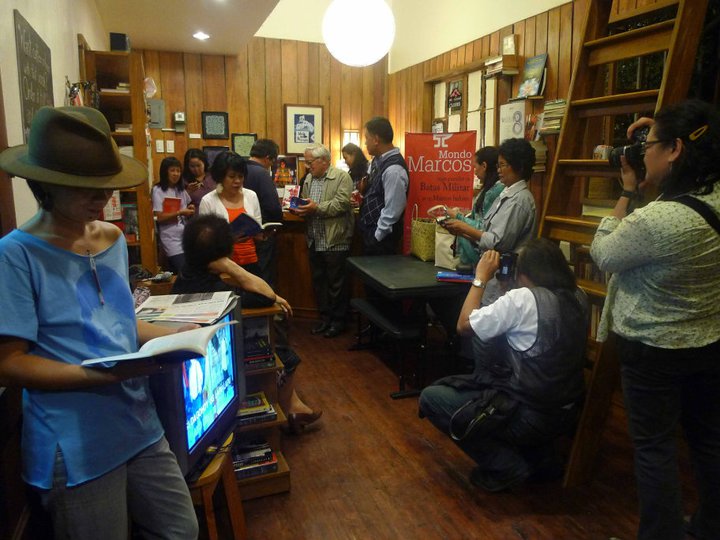
The Mondo Marcos anthology is now available at National Bookstores at P295.00 for the newsprint copy. Buy now! Limited copies only. At least one of the authors will sign autographs if you are within 10 kilometer radius of CLSU.

:-D

Monday, December 27, 2010

MONDO MARCOS SA SUNDAY INQUIRER MAGAZINE


Naisulat na kami ni Ruel S. De Vera sa Sunday Inquirer Magazine kaya bili na kayo. Hindi ko kayo maa-aginalduhan ng kopya kasi wala pa kaming complimentary copy. Heto na lang muna ang Chow Mein mula sa Chinatown ng San Francisco. Masarap na panghimagas sa pasko at pambungad sa bagong taon. :-D

Tuesday, November 30, 2010

Thursday, October 14, 2010

Friday, September 17, 2010

BUY NOW!


The Mondo Marcos anthology is available in newsprint at P295.00 per copy with a 20 percent discount until September 19, 2010 at the Mall of Asia exhibit center during the Manila International Book Fair.

Some of the authors will sign as long as you are within 10 kilometer radius of the Central Luzon State University, Baguio City, or San Francisco CA. :-D

Wednesday, September 15, 2010

MONDO MARCOS IS NOW OUT!


Available at the Manila International Book Fair in SMX Mall of Asia on September 15-19, 2010 from 8:00 am until 10:00 pm.

Bili kayo ha! :-D

Saturday, August 07, 2010

MALAPIT NA!


The back cover reads:

For the first time ever, some of the best Filipino writers recall, cry, decry, metamorphosize, giant robotize, love and Skylab, imagine, re-imagine, televise, sport dance, odify, audify, analyze, saint patronize, assassinate, color (orange), underwear commercialize, monsterize, pornify, necrophilize, shadow box and guava jam with themselves, their friends, their generation and THE LIFE under President Ferdinand Marcos. Mondo Marcos features the fiction, essays amd poems of:

Paula Angeles
Cesar Ruiz Aquino
Oca Atadero
Robert JA Basilio Jr.
SHUBERT L. CIENCIA
Frank Cimatu
Johannis Fernandez
Vince Gotera
David Peter Jose J. Hontiveros
Luisa A. Igloria
Cyan Abad-Jugo
R. Zamora Linmark
Martin Masadao
Apol Lejano-Massebleau
Gabe Mercado
Wilfredo O. Pascual Jr.
BJ Patino
Padmapani Perez
Pete Rajon
Ige Ramos
Sandra Nicole Roldan
Grace Celeste Subido
Eileen Tablos

Bear with me my friends. I’ve never been into something this big, creative writing-wise. :-D

Sunday, March 21, 2010

THE DEATH OF PEDRO AGELA

… in between the spaces of unconsciousness, Pedro Agela caught flashes of an old man’s ghost passively observing him. The brooding melancholic eyes are haunting, as if asking him why. The ghost floated and warped above him until its graying cropped hair and elongated face triggered something vaguely familiar. The memories of far away Almaguer stirred. It bored at his ebbing soul, as if tugging and sucking what remained of his life.

Slowly, a numbing coldness start to consume his body. The pain from hands crushed in the dadapilan, from ribs broken by angry fists, and from the skinned soles of his feet faded. He let out a reluctant cough that spat out the lumps of blood in his throat.

Nearby is a pile of what used to be his sons. The angry unspeaking men who came tied them together before beating them with the chopped firewood gathered from the forest just yesterday. His sons died pleading for their lives, not understanding why.

As the welcome blackness began to return, Pedro Agela once again saw the ghost. The face is younger. Angrier. Then he remembered. The lost lands in Almaguer, the old man with the melancholic eyes and elongated face who said and did nothing, and the old man’s son who left Almaguer in anger. There was just enough time for him to see the angry young man’s lips turn to a sneer of hatred and smile of fulfilled revenge before coldness froze his memories and life forever…


FOOTNOTE: The photo above shows St. Mark's church in Cabarroguis, Quirino. Its construction was initiated by Fr. George Gelade (CICM) who was assigned as the first parish priest of Cabarroguis in 1979. Pedro Agela and his sons migrated from Nueva Vizcaya to Quirino where they were killed. The cause of their murder was allegedly due to land grabbing .

Tuesday, May 26, 2009

KUBRADOR

BANGKING TRIED TO GET UP but unseen arms of the splinted bamboo bed seemed to pull him down. He closed his eyes as the thatched cogon roof suddenly contorted like gigantic waves rushing to engulf him. His stomach convulsed and he puked in an effort to keep from throwing what remained of last night’s pulutan and gin. The glow in his cheap imitation wristwatch said it is 4:30 in the morning. He should beat Barbasan to Lakay Puyot’s house.

He rose from the bed with one final effort, holding on to the sawali wall to steady his sinking feet, drinking the welcome cold morning wind that escaped from an assortment of rusty tin biscuit containers and shiny GI sheet retasos tucked in the walls and roof to keep the rain out.

Except for Lakay Porong who would be sweeping his yard by that time, Almaguer is still asleep. Bangking hurriedly washed his mouth, sprinkling what remained of the water in his head and folding down the unruly tufts of hair with his finger. He grabbed a neatly folded papelito wrapped around an aged yellow Bic pen and reminded himself to be careful in adding up the por lata. One saltod will take away the only work he can do at that time...


ALOT WOKE UP EARLY TO prepare for that day’s interview in the ili. Her Tatang Puyot, long time Apo Kapitan of Almaguer, had arranged a job for her as a clerk in the munisipyo that will pay her P1,500.00 every month.

She poured water into the sooth covered takore and added four scoops of ground barako coffee. Alot always liked the strong aroma of the barako. Somehow, that masculine smell arouses her, like what it is doing now, as she felt the familiar tingling sensation suddenly creeping from inside her up to her hardening nipples.

Last night’s dream was morbid. Alot shuddered as she recalled the big black snake wrapping itself around her body, hissing loudly and caressing her face with its darting forked tongue as they fall into a dark abyss. Bangking will explain to her the anunsiyo from the dream and she will bet on it. That’s what Alot thought as she started pumping water for her bath and mentally listed down what she could buy with a tumbok P10 sahod P5 win…


THE SIGHT OF A WET kamison clinging to the brown skin of Alot’s supine body blew away Bangking’s nasty hang-over. A surprised Alot stood up, covering her proudly protruding breasts with her hands. They stood there for a time, paralyzed by the suddenness of it all, until Alot finally walked to the banyo. Everything in Bangking suddenly came to life, and his heart leapt as he noticed that the banyo has no door. His mind screamed NO! as his feet began to pull itself towards the banyo. Alot is wringing her wet kamison when Bangking walked in. She tried to push him away as he began to caress and kiss her but her hands remained frozen to her breasts.

Manong….”

Bangking stopped.

“What is the lurok for a black snake chasing a girl into a hole?”

Bangking struggled with his words.

Uno and disi-otso for the snake. Treinta for the hole.”

Bangking’s hot gin-laced heavy breath smother Alot, and she felt his roused manliness.

“I’ll put P15 for a 1-18-30 kalut.”

Bangking nodded. Then kissed her. He began to explore inside her kamison. Alot closed her eyes as her hands groped that throbbing sensation pressed in her stomach…

P
ANSIT PHOTO: Pansit canton (and a pizza) from Bay’s Inn in Baler, Aurora.

Thursday, April 23, 2009

CIRCUM CAEDERE

Junie had a restless and sleepless night. He turned ten almost 3 months ago and at that age, he must participate in Almaguer’s annual summer ritual of the kugit. And summer started 3 weeks ago.

“Get up now and eat. You should have a full stomach today so you can endure the kugit”.

That was his mother doing her 5 am ritual of banging the pots and plates while preparing breakfast, calling the chickens to eat and at the same time sweeping the yard. Junie pulled himself up reluctantly, squatted on the papag, and nursed a scalding inky cup of coffee made from boiled toasted rice that tasted like pulitipot with the generous amount of brown sugar his mother stirred in. He tried to eat but the reheated rice from yesterday’s supper and the tough broiled tinapa felt like a lump of pulped cardboard in his dry mouth.

The familiar welcome yelp of their dog Salaki announced his father’s arrival from the taltalon. A muffled conversation between his mother and father, and the sound of the panabas being tucked in the sawali wall completed this everyday habit that always culminated in his father sitting down the papag. They ate in silence.

“Go now. Wrap this around after the kugit”.

He was handed by his mother a strip of newly washed white cotton cloth with a 50 centavo hole in the middle that was torn out from what used to be his father’s old working shirt.

“Take this and give it to Lakay Carling”.

His father handed him 4 sticks of Peak menthol cigarette wrapped in plastic. Then he was off to the karayan.

Junie found 9 boys already soaking and softening their skin in the cold waters of the karayan. He nodded to his friend Abet whom he thought looked so cold and so scared. They were assigned their sequences. He was last and number 10 but Abet who was number 9 pleaded to switch places with him.

After 8 calls followed by the sound of a pukpok, it is Junie’s turn. He started chewing on the mouthful of young guava leaves he picked along the way. The unspeaking and swarthy Lakay Carling commanded him to kneel and close his eyes. He felt the foreskin of his suddenly terrified penis being positioned in a piece of wood, a thumbnail tracing the skin, then pok!.

“Spit it out!”.

But he can only manage a dribble of what remained of the chewed young guava leaves he swallowed after the pok! and the hot searing pain that followed. The first thing he saw after opening his eyes was blood soaking up the white cotton cloth and Abet running away.

Two weeks later, he learned that Abet was bodily carried by his father to the district hospital who was holding a free pakugit spree in commemoration of its anniversary, and that Abet was finally circumcised while bawling out a long playing version of “You Are My Sunshine”.


PHOTO EXPLAINED: Bulan held my hands tight while his Nanay soothed him with words of comfort only a mother could give as our oldest son goes through a symbolic rite of passage from childhood to manhood.

Tuesday, February 17, 2009

ANG HULING EL BIMBO (EXCERPTS)

Ika-3 ng Nobiyembre 1996

Isang araw ay dinalaw siya ng isang diwata, binuhusan ng isang case na beer at sinayawan ng El Bimbo (Talata 2)…

Gustong-gusto na niyang matulog sa opisina, hintayin ang paglabas ng diwata sa bodegang naging kuwartong naging refugee center, at sumayaw ng El Bimbo (Talata 3)…

Ang pangalan ng sigarilyo ko ay “Paraluman Lights”, mabango ang usok nito at marunong sumayaw ng El Bimbo (Talata 6)…

Papalitan ko ang design ng bote ng diwatang naka-lo-waist, nakatanghod sa labas ng trak papunta at mula Bangaan, at sumasayaw ng El Bimbo (Talata 7)…

Si taong-bato-na-malaki-ang-tiyan-at-nagsasayaw-ng El Bimbo ay hindi sumulat dahil siya ay bala ng Torpedo. Si taong-bato-na-malaki-ang-tiyan-at-nagsasayaw-ng El Bimbo ay nagdrowing ng sulat dahil bumubula na ang kanyang kaluluwa sa daigdig ng Marlboro Lights (Gold) at ice cold na San Miguel Beer (draft or regular). Kapag nagsusulat si taong-bato-na-malaki-ang-tiyan-at-nagsasayaw-ng El Bimbo, siya ay nagiging Barangay Tanod (Talata 13)…

At si taong-bato-na-malaki-ang-tiyan-at-nagsasayaw-ng El Bimbo ay hindi maipapangakong kailanman ay hindi na iiyak ang diwata ng mga Barangay Tanod. Pero sigurado si taong-bato-na-malaki-ang-tiyan-at-nagsasayaw-ng El Bimbo na hindi niya kailanman makakalimutan ang pagsayaw ng El Bimbo (Talata 14)…

Ito na nga ba ang huling El Bimbo (Talata 18)…

Hindi pa ako pagod sa pagsayaw ng El Bimbo (Talata 21)…

Hindi na mabasa ng head tape ang lyrics ng El Bimbo (Talata 24)…

Tulog na ang mga lamok pero nagsasayaw pa rin ako ng El Bimbo (Talata 25)…

Baka matuluyan ako’t kidnapin si Paraluman, iuuwi sa Nueva Vizcaya at araw-araw kong isasayaw ng El Bimbo (Talata 26)…

Pagod na pagod na ang taong-bato-na-malaki-ang-tiyan-na-naging-Barangay-Tanod-na-muling-magiging-taong-bato-na-malaki-ang-tiyan-at-nagsasayaw-ng El Bimbo (Talata 28)…

Wednesday, January 07, 2009

SILIP

Butching felt the slimy murk gently swallow the front of his shirt and pants as he lay face down in Uncle Tangad’s duck pen. He dared not twitch, blending his feverish breath and the muffled echoes of his throbbing heart in the orgy of dancing shadows.

The light in the bangsal went on. Butching tensed. That would be the older woman. The light went out and, after what seemed an eternity for him, went on again to usher a silhouette with a long hair that shyly curls at the full breasts where a pair of nipples proudly protrude through a loose and flimsy cotton shirt.

The silhouette reached from under her knee-length skirt and pulled down a pink panty sprinkled with dots of red blossoms which she draped like a panuelo on her shoulders. Butching’s heart raced in anticipation, then leapt madly as the silhouette scooped a tabo of water from a burnay and squatted in front of him. The sound of splashing water was music to his ears. Bits of it caressed his face, anointing his burning soul as he tried to peel the darkness and see what is there, his nose struggling to reach beyond the muskiness of the damp earth to catch even a whiff of that treasured patch so temptingly hidden by the shadow cast by the wane bangsal light. It was his ecstasy.

Suddenly, lights pierced the blanket of blackness. There were voices. The silhouette hurriedly got up, balled her panty, placed it in her skirt’s pocket, and went out to find what the commotion is.

Agtatakaw!”.

The next day, Butching confessed to Kapitan Puyot that he indeed was caught stealing Uncle Tangad’s ducks.

Profile: The Church of Binangonan, Rizal


The ecclessiastical mission of Binangonan was established by the Franciscans in 1621. It was administered by the Jesuits in 1679, by the Augustinians in 1697, and back to the Franciscans in 1737. The parochial buildings were built between 1792 and 1800, and has been renovated several times since then.

Monday, November 10, 2008

BEAT THE STORM, SON...


(NOTE: The following short story appeared in the January-February 1991 issue of the CLSU Collegian. It was the first ever published work of a trying hard fictionist who went by the name of Kimat T. Amianan. The accompanying illustration above was by [now Dr.] Angelito Saliganan.)

He stood transfixed --- hypnotized by the vast green and golden patches of ripening palay, the leaves shivering with every gust of the cool northern breeze creating an emerald sea with waves rippling systematically. Morning dews tenaciously cling to the sheaths, to the intricately woven spider webs, fiercely resisting the radiating heat of the sun, sparkling and dazzling like priceless diamonds.

A colossal figure, he stands five feet and eight inches of solid bone and muscle. The squared jaw and prominent nose added an aura of mystery to his unfathomable expression, the sunken eyes fixed steadily forward. His rich tan complexion contrasted strikingly with a mass of thinning gray hair. He has the looks of a sage and probably, he is.

I call him Amang Lakay. It was more of a name than a reverence for when I was unraveling the mysteries of life, I failed to understand its true context. It’s more of a habit and I got used to it. In fact, I grew up with it.

It was during my sixth year in grade school, I was twelve years old then, when I attempted to probe deeper into that expressionless mask he wore. With childish fervor, I invaded him with questions, some logical, some of plain interest, and other things with stupidity or innocence. He would narrate a tale or two plucked from the history of his rich and colorful life. It may be about his brother Agapito who helped him harvest guavas one summer afternoon… an ordinary story except that his brother was dead three years earlier. Or his experience as the leader of a group of guerillas during the war, exchanging lethal bullets, ambushing the enemy and everything to give the invaders hard life and the worst accommodation they’d ever had.

Nostalgia and emotion overcomes me whenever I reminisce those wonderful evenings we had, together with some cousins, huddled in a dark room illuminated by a solitary lamp, totally absorbed as Amang Lakay took us to another world in a different time.

He brought us to pre-war Philippines --- on what it was long before our fathers were born; of the forest covered mountains, deer hunts, battles, politics, the bizarre world of the supernatural --- of kapres, tikbalangs and aswangs; of elfins, fairies and gremlins. He told us what it was when life was life and man was man.

That was ninen years ago. He was seventy-one then. We were an odd pair --- dusk and dawn. He having spent the best years of his life, while I was still trying to understand what it was. He was rich with experience, brimming with knowledge. I was just beginning to feel what it was like to live, to appreciate and understand the complicated process of life.

It was he who taught me the value of diligence and discipline. “The sweetest reward for a good work is the work itself,” he used to say. He was my first teacher --- teaching me a deeper perception of the world, how to live on what you have, how to be human. It took years but I became the man he wanted me to be.

He had great plans for me. “You’re going to be a good soldier son,” he said one sleepy afternoon. We had just finished eating our lunch of broiled dalag with sliced tomatoes and bagoong, pinakbet the way Inang Baket cooked it, a bunch of yellow bananas. “The art of arms is for real men, for those who feel at ease in the face of danger and peril, for those who feel they are man enough to meet every challenge, for those who know how to apply their principles.”

I can never forget that wrinkled face when, during the crux of my life, he visited me in prison. I cannot endure to stare into his pained expression. He looked so gloomy, so disappointed, so discouraged.

Suddenly, he looked older. He is no longer the strong and determined man I leaned upon whenever I needed support. He is no longer the sage who have an answer to every query. Tears trickled in my cheeks not in self pity but for the man I caused so much pain. He spoke slowly, releasing a charge that pierced the innermost shell of my life.

“I taught you how to become a man. I taught him how to vanquish a foe. But I also taught you how to conquer yourself.”

There was no reproach. What persisted was the mutual feeling we had for both.

And he left, leaving me with his parting words. “Beat the storm, son…” I did.

He died four days before my twentieth birthday. He was eighty. On his death bed, Inang Baket casually asked him, “Are you leaving?” He nodded weakly, flashed a faint smile, and was gone.

When we placed his coffin to its final resting place, I didn’t shed a tear. He hates it. I tried hard to conceal my emotions. I wanted to please him even if he was gone.

He should have been proud of me. Not only that I conquered myself, I also beat the storm. It was for him that I wrote this story, as a tribute to a man who taught me to love life and live with it.

Amang Lakay, eighty years old. War veteran, a hardy pioneer, teacher, adviser, father and friend. He was also my grandfather.

Sunday, June 22, 2008

REMEDIOS IV

I like Gabriel Garcia Marquez so much I named my eldest son after him.


And I am so immersed into “One Hundred Years of Solitude” that the characters have gotten into me. The username for my alternate email is Aureliano Buendia after the colonel but I really would have been his brother the ex-seafarer.

They frolick in my dreams where Ursula becomes my mother and Jose Arcadio the patriarch would watch beautiful Latin American football in my TV. I played a marathon game of pool with the 17 Aurelianos before they were hunted down for the crosses on their foreheads. It was Melquiades who circumcised me along the banks of the dacquel nga carayan; while I was introduced to the joys of exploring the folds of quivering flowers by Pilar Ternera and Petra Cotes. In my deep slumber, Macondo is the enchanted and magical barrio of Almaguer.


Those dreams would stay for a while then slip away into forgotten remembrances, surfacing from time to time in brief flashes of recall before vanishing forever into the recesses of archived memories. That is except for the Remedioses who remained imprinted in my conscious mind long after waking up: the Child Wife who gave birth to a birdman and Lord Voldemort; the Beauty who was one of the only 3 known earthlings to have directly ascended to heaven only to be sent back because all the angels fell in love with her; and Silent Meme, the reluctant hermit, who actually is the great great grandmother of Madonna.

And there is Remedios IV, unknown to the world, a phantom created from the sparks of clashing fiction and reality, born with a daguerreotype from which she looks at the world with sepia eyes. In the fantasy world of dreams, she walks me on to a continuation of Col. Arcadio Buendia’s 32 wars and the characters hiding between the lines.


There are actually 3 more Aureliano Juniors in the lost chapters of the book --- Roberto Aureliano who is to revolutions as fish is to water, and speaks a strange language called Bisakol; and the older Eugenio Aureliano, a He-Man trapped in a body of a beautiful woman. They too read, write and sing poetry in between the eternal wars of their father. The third brother, Ernesto Aureliano, would have preferred to join his grandchildren Amaranta Ursula in Brussels or Jose Arcadio in Rome in pursuit of his passion for painting. But the endless war caught up with him too in Macondo. He is always seen with a rifle and purple flowers grow up in his foot tracks wherever he go.

They are joined by their cousin Josefa Arcadia, the lost daughter of Jose Arcadio who started walking the day she was born. She never stopped since then --- hiking across the mighty Andes 117 times, trekking the Pan American Highway from Barrow to Tierra del Fuego and back, and walking over the waters of the Pacific Ocean and the Amazon River just like a prophet of a long time ago did in the Sea of Galilee. She is the Wanderlust of the Buendia clan who sometimes gets tired but never stops.


The faceless, voiceless and scentless Remedios IV introduced me to these invisible characters. But all I have seen of her are the words that pop out of my email and mobile phone from time to time. She is into revolutions and its art and cultural forms like the Aurelianos, and consumed by an eternal walk like Josefa Arcadia. There are moments when I refused to sleep to block her ghost who sometimes give me nosebleeds with her intellectual analyses of things. Mostly though, I try to trap her in my dream catcher to determine if she really is an illusion or the person who was staring at me from the the next seat in the bus. But when the ghost begin to take the form of the flesh and traces of humanity become visible, it is time to wake up…


Post Script

In the middle of the first half of the 1800s, a young Spanish colonial soldier named Ramon Maria Solano of Valencia was banished from the Viceroyalty of New Granada after the influential Buendias of Macondo petitioned him out for his insistence on renaming their settlement into Almaguer. Stripped of his privileges, Ramon Maria Solano wandered up north until Acapulco where a galleon took him across the Pacific Ocean to the Ever Loyal and Noble City of Manila. There, his sins were forgotten and he was forgiven. He rejoined the colonial government where he rose to become Mariscal-de-Campo, Segundo Cabo, then acting Governor General for 6 months of the 1860s until he died of suspected poisoning. He was interred at the Chapel of San Pancratius of what is now Paco Park that was originally designed by Nicolas Ruiz as a cemetery for the Spanish colonial elite.


Built in the later years of the 1700s, Paco is perhaps the oldest cemetery in the Philippines. The GOMBURZA martyrs --- Fr. Mariano Gomez, Fr. Jacinto Zamora, and Fr. Jose Burgos --- were buried in its grounds after their execution in 1872. Twenty-four years later in 1896, the executed Dr. Jose Rizal was also secretly interred in the cemetery. His remains were later exhumed in 1912 and moved to what his now his grand monument at the Luneta. Interment in the cemetery was prohibited in 1912 and most of the remains of those who were buried there were transferred except for that of Ramon Maria Solano who after his death has a town in Nueva Vizcaya near the ancient barrio of Almaguer named after him in his honor. Paco Cemetery became a national park in 1966.

CAUTION: This is a work of fiction and nothing else.

Thursday, September 27, 2007

JUANA AND THE SAINT

JUANA is on her way to fetch water from the river when the Japanese finally came to Baloc. “So these are the mighty conquerors”, she mused as a column of dusty tanks and trucks passed by carrying small men with small eyes in drab olive uniforms. Except for the guns, they seemed harmless but with their arrival came a pall of unbearable sullenness in the barrio. She quickly turned back to their dampa. Her friend should know.

“I’m worried about Juana”, a shirtless middle aged man said to his wife who is preparing the sinaing for lunch. The wife paused to look at their daughter rush into the abong-abong near their house that serves as the Aglipayano chapel. Juana has been spending most of her time there ever since the santo was brought in. It is where she eats her meals that she says she shares with the santo. She roams the forest everyday to pick fresh flowers for the altar. And they can hear her talking to somebody they can’t see. But they are too afraid to stop her.


A few months after the war, Juana suddenly became ill. All the albularyos that came failed to cure her. “Sinaniban,” they all agreed as they watched Juana’s body contort in periodic spasms, as they tried to discern the strange words she utter. They and the neighbors came to hold vigil and say the novena. But one night when everybody strangely fell asleep, Juana disappeared from her sick bed. They found her the next day prostate before the santo, arms spread like a cross and in deep trance. A week later, she started healing the sick.

One day, Juana’s father and some neighbors are huddled under a kaymito tree. “If it won’t rain today, the rice crop will be lost. Where will we get food?” they worriedly tell each other. “Go and bring out the santo!” commanded Juana who seemed to have appeared out of nowhere. The terrified men did as told, too scared to argue with the young woman. When they brought back the santo after carrying it in a prusisyon all over the barrio, it rained hard. It did not stop for 5 days.


And so the sick and those who believed came, seeking Juana’s cure and blessing, lighting red candles to bring their prayers to the santo. And yet another drought came but the santo would not budge as they tried carrying it for the prusisyon. “Go home,” Juana said, “The rain will come tonight”. It did for the next 5 days. And the faithful multitude increased…


BERTONG LANGIS never failed to attend San Geronimo’s feast day in Baloc ever since Olan came to work for the prophets. But it’s more for the pulutan that Olan’s wife prepared so well and the bottles of Colt 45 chilled in the basin of a washing machine. It was only recently when he came in the spirit of the panata (and curiosity), walking to the 3 churches of the Aglipayanos, Father Ahyong’s sect, and the Catholics who share the same patron saint. The highway is clogged with people and stalls. The churches are crammed with the faithful. But the star of the fiesta is Juana’s santo where the mass of believers slowly inch their way from the churchyard gate, inside the church, to the altar to touch the image and say thank you and ask for more favors.


PHOTOS (top to bottom): (1) The faithful inching their way to the Aglipay church (2) while those inside are crammed as they pay their devotion (3) to the image of San Geronimo. (4) Vendors and stalls of red candles, (5) Sto. Ninos, and (6) rice cakes litter the church compound and compete for attention. (7) The faithful also come to Fr. Resty Ahyong’s breakaway sect and (8) Baloc’s Roman Catholic church.

NOTE: This story is fiction but Juana is a real person.

Thursday, July 26, 2007

A YEAR OF BLOGGING

Oyet P. read us a poem during NE Branch’s Christmas party of 1993. I heard he went to work in Bangkok after that.

He was heady with that Nora Aunor thing the first time he came home. I got a bottle of Absolut Vodka for a pasalubong and he filled me in with his trip to Sta. Maria, Ilocos Sur where his ancestors from the father side originated, showing me a photocopy of his great grandfather’s birth certificate written in flourishing old Spanish script. We went hiking and spelunking in Minalungao before he went back to Bangkok.


In 2003, I finally broke the jinx of being one of the few in PRRM who never got to use the “out-of-country” alibi. I was in Thailand for almost 3 weeks that year and on my first night in Bangkok, Oyet P. gave me a hurried city tour. He showed me the Temple of the Dawn and the nearby night flower market, walked through bustling Simlong Road and seedy Pat Pong, and snacked on deep fried scorpions and bamboo worms in Khaosan Road. Later on our last week in Bangkok, me and Ponga (i.e. Egay Paraguison) cooked him a dinner of sinigang na ulo ng salmon and sisig. We had Singha beer while watching his “Dara ken Lasag” family documentary and learned how the Americans bribed a little boy with candies who innocently ratted where the great Apolinario Mabini was hiding in Cuyapo. That boy is the brother of his great grandfather.

Oyet P. attended a lot of creative writing workshops after that (one is something like a loaf of bread in New York) although I thought there was no need for him to do so being the great writer that he is. Then his essay on Nora Aunor won him a Palanca grand prize. We gave him a bash and held an impromptu poetry reading in his honor at the garage of the NE Branch office. That was when he really got us going on creative non-fiction.


I really didn’t think much about creative non-fiction. I had long come to terms with the mediocrity of my writing skills despite Oyet P.’s insistence that I can really write. Sure I am better than the average guy but I’m not that good enough to win a Palanca or earn a living writing stories. It’s safer to stick on writing those stupid reports, case studies, project proposals, and what you got. I even write love letters for a few bottles of beer.

Anyway, my odd Hispanic family name really fascinated me and decided to find out something about it someday. I did on one of those trips to Manila, taking the McArthur Highway instead of NLEX, and dropping by the Obando church. I started visiting relatives and dropping by familial places like Umingan, Cabugao, Baguio City and Manila’s Sta. Ana district. Slowly, the dots began to connect and surprising new information emerged. I was able to fill in most of the gaps from the multitude of relatives who came when our mother died in 2004. Now, I have a story.

My first blog article was posted exactly one year ago. It is a short narrative about my trip to Obando and what I’ve found there. Like my forgotten poetry and will-do-won’t-do attempt at creative non-fiction, Oyet P. inspired the blogger in me. My theme is old colonial churches because I like visiting them and their past although this is something that floored my friends being the self-declared agnostic that I am. And pansit of course for the simple reason that there must be something to break the monotony of those creepy and batty old churches.


There’s not much fan mail but the few that came blew me away. Like Manong Ben Guadiz from Colton, California whom I exchanged several interesting emails on Almaguer and NELA; book editor Cecile Pastrana from Makati who gave me the ultimate compliment of “bahagi rin ng kasaysayan ng ating bansa ang iyong mga itinatala”; and several more who either gave their encouraging compliments or were inspired to embark on their own search. So far, my cluster map has recorded more than 7,000 visits to my blog since 26 July 2006.

Being a citizen of blogsphere, I have my own blogging family. Numero Uno of course is the master and my maestro Oyet P. There’s future ex-Palanca winner, funky story teller, and just-turned-freelance Jun Lisondra who introduced me to Technorati, Picasa and other instruments of blogspace; will-be-a-nurse-and-go-to-the-states Meg Manubay of Pugad Baboy; fellow NGO worker Amy Salazar who’s the much, much better half of my Pareng Zos; haiku and tanka master Romy Halabaso of OPAPP; and shutterbug and salagubang collector Stan Cabigas.


There’s also what I called the exorcist bloggers who have the uncanny power of driving my demons away by just reading through their blogs: witty and prolific Frank Cimatu, the mysterious but insanely entertaining Maui Pacquiao and Mandaya Moore, and the intriguing Sarah Grutas.

Early this year, I linked my blog to flickr and was later gifted with a pro account. I decided to upgrade and retire my Olympus Camedia and got myself a Nikon D40. Jun Lisondra told me that my theme of churches and noodles are too limited for the stories I have to tell. Oyet P. on the other said something about finally finding my voice. After a year, this blog is changing title.


PHOTOS (top to bottom):
(1) Apo Oyet P, (2) Oyet P. and Ate Guy in New York.

(3) CHURCH OF SANTA CATALINA (ARAYAT, PAMPANGA). Arayat is named after its majestic mountain. Like the Macabebes, its people are known for their loyalty to Spain. It was accepted by the Augustinians as a mission in 1590. The first parochial buildings were made of light materials. There are no records on who built the succeeding churches including the present one. In 1706, the Chinese population of Bangabong, Carranglan, and Pantabangan were relocated to Arayat upon the orders of Governor General Domingo de Zabalbaru allegedly to prevent them from spreading their bad influence. In 1858, Fr. Jose Torres (OSA) had the present church restored. This was continued during the term of Fr. Juan Tarrero (OSA) and completed under the supervision of Fr. Urbano Beduya in 1892. Several renovations have been conducted since then.
(4) Rowen’s (of Agrarian Justice Fund) birthday pansit, (5) Pugad Baboy members (from left to right) Doro, Meg Manubay, Jun Lisondra, Zos, Lolay), (6) me playing with my new Nikon D 40.