From a $135 hotel offer for a 3-hour private tour to a 110 soles half-day quickie.
Only a mad man will take the first option while the second one unfolded as Senor Taxi Driver took me, for 16 soles, to 599 Avenida Jose Galvez Barrenechea in Lima's San Isidro District where I have an unexpected but pleasant encounter with several Hermanos from the Gran Logia de los Antiguos Libres y Aceptados Masones de la Republica del Peru.
I came to take photos I said.
But the Lodge is closed and they are on their way to an installation ceremony they said back.
I was introduced to their incoming Grand Master and was asked if Spanish is the medium of our ceremonies in the Philippines.
It was a beautiful sunless Sunday of deserted streets and my being the Prince of Lucky Chances was again affirmed.
From there to the UNESCO World Heritage inscribed historic center of Lima is 20 soles and that's where I made Senor Taxi Driver an offer he can't refuse on a slow Sunday morning: 100 soles for a rapid photography tour of the churches of Santo Domingo [Dominican], San Agustin [Augustinian], and San Pedro [Jesuit].
He gave me a big smile, nodded, and as an introduction and perhaps a token of his gratitude took me first to two unknown churches.
"Bonito!" he said, and I agree.
And then a pink bell tower emerged from the skyline announcing our taxi's arrival at the Iglesia de Santo Domingo, built on the encomienda of Fr. Vicente de Valverde during the late years of the 1700s who is to Francisco Pizarro as Fr. Andres de Urdaneta is to Miguel Lopez de Legazpi, host to the remains of three Peruvian saints [San Juan Macias, Santa Rosa de Lima, San Martin de Porres], and founding site of the first chartered university of the Americas [National University of San Marcos, in 1551].
The taxi made a corner turn to the Iglesia de San Agustin and its intricate Churriguereque baroque facade which is one of the only two left in Lima [nee Iglesia de la Merced], its unusual blocked design masking its 440 years of history of which nothing much is offered by Wikipedia except its devastation during the 1746 Lima-Callao Earthquake and the 1895 factional war between the Pierolists and Cacerists.
Finally, uno mas.
The taxi parked at the curb but there's nothing much to be said of the Iglesia de San Pedro except of its completion in 1638.
Back at the hotel, I added a 20 soles tip to Senor Taxi Driver's services.
He was grateful.
So is the other Senor Taxi Driver who took me to the airport for another 20 soles tip.
So am I to the netizens who made my 17th wedding anniversary post card the most liked of all my Facebook posts.
My friend Prabin Man Singh from Oxfam-Nepal has never been inside a Catholic church.
So I asked him that if he did not have any plans after the Lima People's March and a heavy carnivore lunch of pollos a la brasa, then perhaps he would want to join me in a walking tour of Lima's great churches.
We first got lost of course, before stumbling upon the Basilica of Nuestra Senora de la Merced --- an 18th century elaborate Spanish baroque [i.e. churrigueresque] church with more than 400 years of history and dedicated to the armed forces of Peru.
Lima is relatively safe.
The only thing to watch out are strangers intent on making a conversation which a passing man tried when he asked me about the time and then where I came from.
He was dismissed him with a wave as we continued walking to the Plaza de Armas and the grandeur of the Basilica Cathedral of Lima: the keeper of Francisco Pizarro's remains who helped build the first church in 1535, host to a trove of religious art and history, and adorned with 14 chapels of various saints.
Prabin wondered why people are buried in the church and I told him that's the old way when rich people can opt for a church burial to be nearer to God, and that we should also visit the catacombs of the Convento de San Francisco if he wants to see more old bones.
We did and barely in time for an English tour of the monastery where we were introduced to [1] a carved image of a crucified Christ that came from the Philippines, [2] paintings by the Spanish master Francisco de Zurbaran and of a Peruvian version of the Last Supper by Diego de la Punte, and [3] the catacombs and some of the remains of the 25,000 buried there until 1808.
The church and the convent was started to be built in 1673, and I would learn later from Wikipedia that the convent is in fact known for its collection of 25,000 antique manuscripts, and the next day that the lone Filipina woman in the tour is in fact Rep. Susan Yap of the Philippine delegation to COP 20.
Prabin ended his initiation to Spanish Colonial Church 101 in a souvenir shop where he bought an assortment of apparels for the cold Nepalese winter.
Mine were some alpaca shawls, souvenir t-shirts, and a Peruvian sweater for the wife.
I can't actually remember the last time I joined a march [i.e. mass action/mobilization].
Was that the one that ended at UP-Diliman, or that where I was photographed tying together the banners of LFS and MASP?
What I'm sure is I was single then with my trademark overused bristling toothbrush sticking from the back pocket of a torn and faded fake Levi's, tubao draped over a blazing batik shirt, threadbare mojo sandals, and no money to buy even a stick of Winston Red.
That was like ages ago.
Until the perks of a yellow badge finally brought me back to the streets where I learned more than what was taught us in the university.
The 5.5-kilometer People's March for Climate Justice took some 4 hours as a massive column of around 20,000 people from around the world got stuck at the Campo de Marte before traffic broke it into platoons that eventually regrouped on the approach to Plaza San Martin.
Lima have not seen such huge march in a long while.
Neither do I.
Without me knowing it, I have arrived at Lima's Historic Center...
Dear Pinky,
I miss you and those cold poorly lit rooms where negotiators fall to sleep, wake, fall to sleep, wake, and fall to sleep again.
Those late lunches and missed dinners seem just a fortnight ago last March in Bonn when the omen of your imminent leave was first made known, then in Bonn again last June where you were finally taken and I have to take refuge with Menique.
I tried taking you back last October for Bonn.
And again, with more effort, for Lima although I know the odds are not in my favor.
Menique would have taken me back but I thought I go with Amarillo first and pray that the first week would be good to me.
I thank my Oxfam Family for making Week 1 happen.
Walls have been torn down and I am grateful, although it took awhile to adapt with Amarillo's preference for crowded computer tables, dead hours and early lunches, and the early trips back to the hotel which somehow inferred that this is a strange COP.
Strange, slow, boring, procedural, and even fetid.
So I thought that perhaps next year in Paris would actually be the better time to reunite with you as I thank Menique for again considering me, except that I would be so strung going badge-less and doing nothing in Week 2 since I can't really afford the $1K 3-day/2 nights tour to Machu Picchu and it's too early to visit them churches.
I thank my Ateneo Family for making Week 2 happen.
I am thankful to the door keeper who allowed me to watch in the CCTV Caballero Juan Hoiffmaister deliver a statement in behalf of the G77 and China.
I am thankful to a Fil-NZ colleague who also came for a Week 2 badge and kept me company for two hours.
And I am thankful to the UN guard who told me to leave because if not for that, then I could have never experienced the crunchy but delicate taste of Lima's Turrones.
In other words my dear Pinky, you are not worth the hassle with this kind of COP.
So I'll be seeing you next year, either as Kulay Rosas or Menique.
That I can promise you.
Truly yours,
El Hombre con el Distintivo Amarillo
PS: I am actually an Atenean by virtue of a certificate on Financing Local
Development from the Ateneo School of Government in Rockwell. At least
that's what the dean told us when we finished the course.
I hate red buses.
Especially double deckers with open tops and guides who speak like recorded voices.
Oh, I hate them all!
You are not allowed to get off, and you have to fight for space to get a photo that turns out to be crap most of the time.
But the Man-with-the Green-Vest did not show up [or I did not see him] at the Parque Kennedy for the walking tour to Lima's Historic Center.
So I reluctantly got pulled to a 10-soles bus tour of the Miraflores District after the padre said "Amen" at the Parroquia La Virgen Milagrosa.
"Here are the ruins of the Huaca Pucllana!" announced the guide who gave us two minutes to gawk and photograph.
The bus whizzed by several churches and left their memories in crappy photos.
And then the Pacific Ocean and imitation Nazca lines and a monument to a kissing couple to an expensive seafood restaurant jutting from the coast and a foggy panoramic view of what can be the Costa Verde to the glass buildings of upscale Larcomar.
Finally, redemption as the guide segued to a winding epilogue across pavements abandoned by a Peruvian national holiday into a late lunch of carnivore proportions.
Thank God for a salad bowl of avocado and whatever.
But I still hate red double deck tourist buses.
From the longest flight to the slowest and boring-est CoP ever.
From 4 years of being a sleep-deprived pinky and to the comforts [and limitations] of a yellow badge.
The drums rolled when I walked into the grounds of the Cuartel General del Ejercito del Peru [aka Pentagonito], not because of my arrival, but to herald the sad reality that I have lost the the right to the informal informals, temporarily, and by choice.
That justified two shots of a Pisco Sour in the middle of the first day, until the Bearded One came and assured me that we were in fact two pinkies who have gone yellow.
Also temporarily.
Also by choice.
An accidental pansit [i.e. Thai salad with fried noodles, orange wedges, and sesame-coated chicken strips or something like that] from a restaurant along Avenida Diez Canseco made up for this lost week, and perhaps more when things pick up in the second week as negotiators jump from the tranquility of a wait-and-see into the tumult of a coffee-powered do-or-die last two days [why it it always like that?].
But then, there were walls torn down and the realization that colors don't really matter [only the work load] plus a team that stayed united and the company of friends who never left as a fusion dinner of adobo, kaldereta, chifa, salad green, and penne vanished with the wine and Cusquena Lager before the short sweet walk from Paseo de la Republica to the Hotel Los Girasoles.
But there could have been lots of it, the noodles, at Dad's World Buffet, like pots of pansit malabon and a pasta station, except that I came for the sashimi and the sushi while others queued for the comfort of regular Filipino cuisine.
The biking too which could have happened for three days after Monday, except that what I must do and leave behind outweighed the itch that is that church in Licab, and that of Nampicuan and Zaragoza, which will conclude Ariel Guieb Tangilig's quest in Districts 1 and 2.
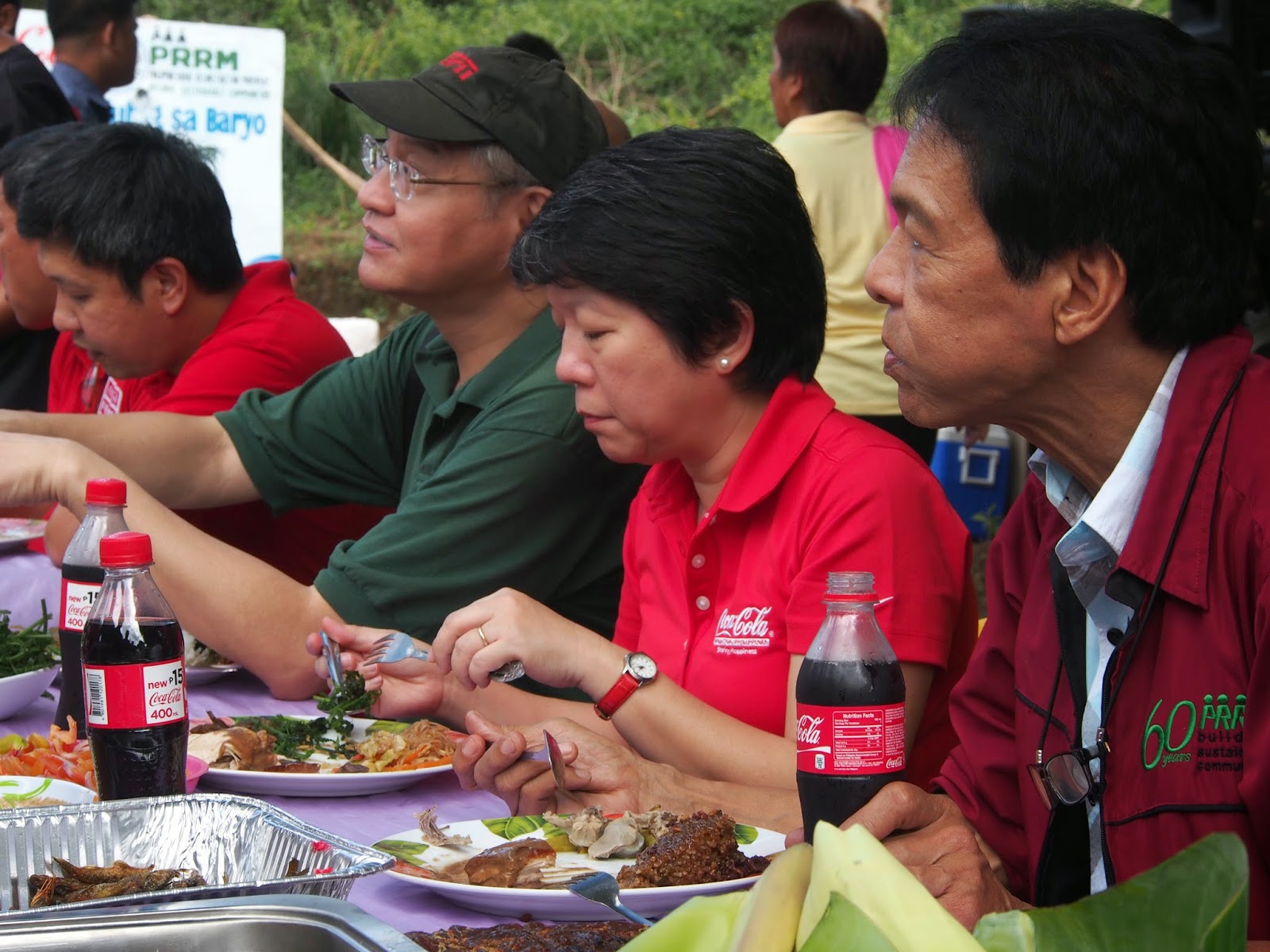
The Coca Cola Foundation did bring Coke to a buffet of deep fried biya, an assortment of meat including the head of a roasted pig biting a can of Coke Zero, and a Coca Cola cake but no pansit or the Coca Cola version of it whatsoever.
In Balanga City, there was what looked like glass noodles garnishing a plate of cold cuts at at the Fortune Hongkong Seafood Restaurant, too unattractive perhaps as it remained untouched, uneaten, unappreciated unlike the Hototay Soup, garlic crabs, sweet and sour lapulapu, fried chicken, and the chop suey that it came with.
Then back at Dad's World Buffet, to its lonely pansit table and pasta station, and Bokyo's first encounter with gluttony...
...before the longest flight ever from Manila to Tokyo [4+2 hours] to Atlanta [12+2 hours] to Lima [6+2 hours] made bearable by John Favreau aka Carl Casper cooking spaghetti aglio e olio for his waitress mistress before losing his wit to a food critic, quitting his job, and discovering the seduction of a food truck and a Cuban sandwich [i.e. "Chef"]; the endless conversations between Steve Coogan and Rob Brydon as they explore glorious Italian cuisine including a pasta and ravioli scene [i.e. "The Trip to Italy]; and the travails of an Indian family of cooks and a Michelin-starred French chef, Manish Dayal aka Hassan falling in love with Charlotte Le Bon aka Marguerite, his two Michelin stars, and the pasta that must have been part of the menu [i.e. "The Hundred-Foot Journey"].
Delta eventually served Japanese breakfast noodles but that was eclipsed by a can of Miller beer before Flight 151 finally descended into Lima.
El ciclista ha aterrizado!