
Because televisions then were powered by batteries, it has to be turned-off during every commercial to save on electricity. Everybody tensed when the black-and-white picture start to diminish indicating the decreasing battery power. And this always happen when he goes riding off on his horse to rescue a damsel from the bad guys.
Channel 13’s Piling-piling Pelikula was always a big event as Abet has witnessed in Almaguer, Mapandan, and Paniqui. At least for the kids. This they anticipate for 1 week especially if it’s the fast-drawing-and-shooting hero who can kill a battalion of kontrabidas and seemed immune to bullets. There is one rule among the TV viewers: no farthing please.
He was Geronimo, Leon Guerrero, Julian Valiente, Diego Santa Cruz, Pedro Tunasan, Zigomar, and Julian Vaquero. How we would like to be like him then.
After high school, he tried the movies as a fledging stuntman doing mostly “extra” roles. But he’s got the looks and perhaps the talent of riding horses, cocking a gun while sumersaulting in mid-air, and doing the rapido that culminates in a pompyang. The kids liked his movies and he soon become the country’s numero uno action star.
This is the fame that made him vice-governor of Pampanga, governor, and a senator of the republic. Now, he wants to become the mayor of the country’s financial center too.
Actors must have liked being family men because like a former president, an almost president, and a father and son in the senate, he’s got multiple family ties. His eldest son Manuelito is with former Miss International Melanie Marquez while his next 4 children is with his legal wife Marissa Tadeo, one of which is now the incumbent governor of their province.

Manuel Mercado Lapid was born and raised in Porac --- a town that was first established as an Augustinian mission in 1594 and named after the purac tree. Like many missions, a church was built: first of light materials that was replaced with a stronger structure during the 1710-1734 period by Fr. Manuel Obregon (OSA) and Fr. Nicolas Mornier (OSA), then in 1872 by Fr. Isidro Bernardo to replace what was probably destroyed in the 1863 earthquake. This church was renovated and restored in 1877, 1884, 1950, and 1990.
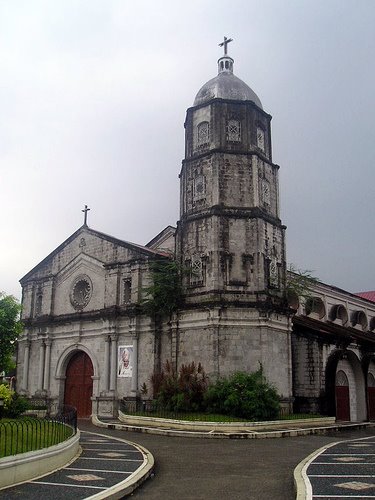
Adjacent to Porac is the sleepy town of Sta. Rita de Baculud/Sta. Rita de Lele. It was established in 1722 but because of its “economic and juridical conditions”, church building was started only in 1839 by Fr. Francisco Royo (OSA) then Fr.Juan Merino (OSA) presumably through funds donated by Don Alejandro Rodriguez.

Lito Lapid’s koboy image suited him fine in the movies. He should have just stayed there and make the kids of Almaguer happy.
PHOTOS (top to bottom):
1) Action star turned politician Lito Lapid.
2) Gov. Mark Lapid (left) and dad Sen. Lito Lapid (right).
3) The churches of Porac and (4) Sta. Rita in Pampanga.
CREDITS: Lapid photos and information from Wikipedia.
.jpg)
I forgot the brand and specifications of our first camera. It has a silver color and one of those models where you have to peek down the viewfinder to take a picture. It was a gift from my Dad’s American friend. Abet and Eric’s photo in the banauang in front of Amang Lakay’s house in Almaguer is our sole remembrance of it. The camera was given to me when it broke down and I have happy memories of being the neighborhood kids’ “photographer”.
Later, I dabbled with an old black camera during my college days that was given as a gift to the campus paper by the university president. It was, however, pawned by one of the staff writers before I can fully enjoy it.
I consider these my early flings with photography. What might be first love happened when I am already working with the Philippine Rural Reconstruction Movement and with an inky black Cannon that looks like those hand held movie cameras which everybody seem to have now. The surviving photos I took with this camera are now posted in my flickr account and include a trek to Battad in Banaue, Ifugao for a friend’s alternative stag party; photos of Boracay Island in Aklan and El Nido in Palawan where we have two of our company’s multi-day (and boring) workshops; and those of Baguio City during a conference. My affair ended when the camera disappeared from our office.
What followed were a series of “one-night stands” with various cameras: Egay Paraguison’s Instamatic in Bangkok 1, Bohol, Singapore and Jakarta; and a company camera with a manually adjustable lens that I borrowed for Bangkok 2 and 3). Then I started going to churches and decided to finally get hitched.
My Olympus Camedia digital camera is not actually mine but our company’s. I bought it in 2004 for around P19,000.00 at the Villman branch in West Avenue, Quezon City. I really have to convince my boss for that camera who finally relented when I proposed that the cost be taken from my operations fund and that it will be used in documenting company activities.
And so it was that I embarked on a visita iglesia (with the original intention of breaking the monotony of my constant travels) with my Olympus Camedia with its 4,000,000 effective pixels, 5.8 mm to 17.4 mm lens, ½ to 1/1000 second shutter speed (2 seconds for night scene mode), and an effective memory of 16-256 MB. I actually didn’t care on the specs because frankly, I don’t know what these mean. I’m fine as long as the camera worked. It will be 2 years later before I finally read the user’s manual and got introduced to the camera’s shooting modes and other features.
In the Christmas season of 2005, I redeemed the points I earned in my “Laking National” loyalty card and bought myself Michael Busselle’s “100 Ways to Take Better Photographs”. I consider the book as my first training in photography. Poet-cum-techie Jun Lisondra also guided me through the intricate technicalities of photography by enlightening me on pixels and introducing the wonders of Picasa.
In my 37th year, I gifted myself with a flickr pro account after being inspired by Maestro Oyet’s prodding to start a group on simbahans and pansit. Instead, I joined several groups whose outstanding photography exposed the engot in me. For a moment, I was ready to quit but then Abet told me, “This like college, man. You will learn and you will survive”. I do hope so.
For me, my flickr pro account is an advance course in photography and I will be thankful for viewers of this blog who can share tips in improving my photos. It is also a tribute to my Olympus Camedia who never failed me, and a way of sharing my passion for Philippine colonial churches (and other places of deity worship) however blurred, dark or tilted the photos may be.
So far, my Olympus Camedia has taken more or less 4,000 photos. It has traveled with me across the Philippines and to Cambodia, Pakistan and Japan. It is a witness to both the happy and sad moments of my family, the many meetings/workshops/conferences/trainings related to my work, and the secrets that goes with life.
Early this year, I went camera hunting with some friends in Quiapo’s Hidalgo Street. I fell in love with a Nikon D40 which Mang Ramon offered for P26,500. I was taking out my ATM card from the bag when I came across my Olympus Camedia, the markings erased with age, its silver coat pale with use, the lens barrier now loose, and evidently gurang compared with the sleek new models. It seemed to tell me, “One more year, boss”. Yes, one more year…
(Photo above taken in an art gallery in Yufuin, Oita City, Japan)
What is now famously known as mami started as a hot bowl of bami (i.e. from its main ingredient of ba or pork strips and mi or noodles) that was a popular street food of old Manila. The evolution to mami is attributed to a Cantonese immigrant who substituted the pork with chicken strips. Its price range of 5 to 30 centavos per bowl was affordable to most Manilenos who quickly fell in love with it. They called the new dish mami or Ma’s noodle in honor of its originator --- Ma Mon Luk of the famous mami house chain. Today, the only remaining Ma Mon Luk restaurant is that along Quezon Avenue. A small bowl of the original recipe cost P90.00 that goes well with their special siopao asado with chicken meat and salted egg which is P50.00 per bun.

After a visit iglesia to Binondo’s Basilica Minor of San Lorenzi Ruiz and the Church of Nuestra Senora del Pilar in Sta. Cruz, I decided to finally try the famous Ma Mon Luk mami. It was lunch time and the place is full. Ordering took around 20 minutes but the wait is worth it. The hot soup is just right, not too garlicky like the usual mami and topped with tangy chopped onion leaves and tasty chicken strips. The noodles are pasta-like which is just the right texture and a welcome change from the usual oily and rubbery mami egg noodles. It goes well with the equally renowned siopao which inspired the urban legend of it having cat and mouse meat filling to discredit its fame. I recommend washing it down with an ice cold glass of sarsi.


The Filipinos’ love story and addiction to the mami reached such proportions that when the lowly Payless Instant Mami was introduced, it became an instant hit and is now the unofficial national dish of the masa. There are now different brands but to the common tao, they are all Payless and the same. It has evolved countless variations like our favorite CLSU days ulam of 1 pack of Payless with the noodles broken into pieces, a pitcher of water for sabaw, salt or patis to taste, and 10 fronds of malunggay leaves. I swear this is enough to feed 8 hungry people. The weirdest version I have seen is that of Sto. Nino III’s Attorney Tantan: 1 pack of instant mami mixed with Jack ‘n’ Jill Chippy (original flavor) and 2 pieces of balut!


PHOTOS (from top to bottom):
1) The famous Ma Mon Luk mami and siopao.
2) BINONDO’S BASILICA OF SAN LORENZO RUIZ. The Dominicans established their Binondo mission for the conversion of Manila’s Chinese population in 1587. Nine years later and two years before the mission became an independent parish in 1598, the Dominicans started building a church that was completed by 1614. A new structure was built when the church was transferred to its present site sometime in the 18th century. The church was damaged during the British invasion of 1762. Repairs and improvements were conducted in 1778 until 1781. It was handed over to the secular clergy in 1768 then back to the Dominicans in 1822. The church suffered damages during the 1863 earthquake. It was again handed to the secular clergy in 1898. The church and the convent was restored and improved from 1946 until 1971.
3) STA. CRUZ’S CHURCH OF NUESTRA SENORA DEL PILAR. The Jesuits who administered the church until 1768 built the first structure of wood and stone sometime in the 17th century. It was the site of the British’s return of the city of Manila to Governor-General Simon de Anda in 1764. Fr. Agustin de Mendoza initiated the church’s reconstruction in 1868 after it was destroyed during the earthquake of 1863.
4) Payless Instant Mami (Lean’s Mini Mart, Science City of Munoz).
5) My favorite instant mami recipe: firm chicken flavored Nissin’s Ramen noodles, not too soupy, and 1 beaten egg stirred in after the cooking and before serving it.


.jpg)


