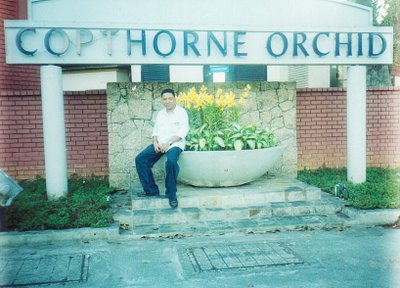
On June 28 to July 5 of 2003, our company and its partners went to Indonesia for a study visit on the Parlemen Indonesia Untuk Kapendudukan Dan Pembangunan’s (IFPPD) family planning advocacy program. On the way to Jakarta, we had an overnight stay at Singapore’s Copthorne Orchid Hotel where we were treated by Doc Glen to a dinner of Singaporean noodles. I woke up early the next morning determined to hunt down a street called 57 Oriole Crescent. But Singapore is too big for a 2-hour exploration and we (the “Packard Boys” tagged along) turned back after reaching Singapore’s Management University.
57 Oriole Crescent is where Precy worked in Singapore in 1984 after quitting her teaching job. She left when Abet was on his first year at NELA in Alicia, Isabela where he was awarded a partial scholarship, and in abeyance of Apong Ino’s decree that all the children of Almaguer’s Sabadistas should attend high school there. He stayed at a dormitory that looks more like a military barracks with its rows of double deck beds, its dirty toilets and kitchen, and endured the school cafeteria’s daily menu of vegetarian food.

Kid Buntal brought Abet his first real shoes --- a red Adidas Hurricane and an Indian moccasin made of fake leather --- with the first money Precy sent home. Abet also had his bell bottoms bastonized with matching zippers. On weekends, he would ride a bus to Santiago to watch movies and for his favorite snack of the best pansit luglug he ever had (I tried looking for the restaurant where it was served many years later but it seemed to have closed down). This was also the year of Lolo Porong’s death in Auntie Angeling’s house in Almaguer. On his last moments, Kid Buntal ran to his deathbed shouting, “Patawarin mo ako Itay!”. They did not really have the chance at that father and son thing.
Abet planned to make it good in NELA but he carried with him the curse of Almaguer that doomed those who came before him, with him, and after him --- except Precy because she was an angel. He protested in silence when he was dropped from the school choir, and cried his failure to make it to the Dean’s List. After these setbacks, life in NELA was never the same again. Abet’s younger brother joined him in NELA a year later and, together with the children of other Sabadistas from Almaguer, they would will escape the tedious and boring Sabbath services that usually starts at Wednesday nights, then Friday nights, then the whole of Saturday until sundown. Their favorite hideaway is under the Paddad Bridge where they talk about the most beautiful girls in school, the scary Apong Ino, and the latest names they have given their teachers. Abet tasted his first liquor in NELA --- a pocket sized bottle of Andy Player Special whiskey with a pulutan of kropek. Later, Kid Buntal and their younger sister joined them in NELA. They stayed in a rented cottage with crooked posts, slatted bamboo floors, splinted bamboo walls, and a cogon roof.
Precy stayed for only one year in Singapore. She came home to Almaguer because she did not know that her whole family has moved to NELA. Abet was on an errand to Almaguer when she came looking for them in NELA. The first thing she did is to wash all the clothes and blankets. She also built a new and bigger cottage with the same crooked posts, the same slatted bamboo floors, the same splinted bamboo walls, and the same cogon roof. But she was too late for her two sons.
Abet’s rebellion started slow --- swiping a cooking oil from a neighboring cottage, then slaughtering one of the teachers’ chicken. He got caught in these two adventures. He learned to skip classes and would disappear to Roxas among Inang Baket’s relatives, or at Lolo Piryong’s law office in Santiago. His greatest moment of triumph is when he defecated in the desk of one of his teachers. He can hardly hide his glee at the school’s frenzy in trying to find the culprit. This time, he did not get caught. His last infamous act is harvesting the underwears left to dry at the Girl’s Dormitory and hanging these in the flagpole. There they wave during the next morning’s flag ceremony --- different sizes from awesome to really sexy, different colors from sensual black to fresh white to outrageous polka dots, and different brands from So-en to Triumph to fiesta baratillo. He was caught and was again sent to the aircon (i.e. the principal’s room) to face NELA’s inquisition. The whole bunch is there --- the principal, the pastors, teachers, dormitory managers, the cook and janitor, and probably even Jesus Christ. They are not smiling and they talk among themselves while Abet’s bones shake with cold. After one hour of this, they solemnly told him to go home. And so Abet left NELA as a young man and went home to Almaguer. His younger brother --- and some more from Almaguer --- will have the same fate.
The Jakarta Interlude
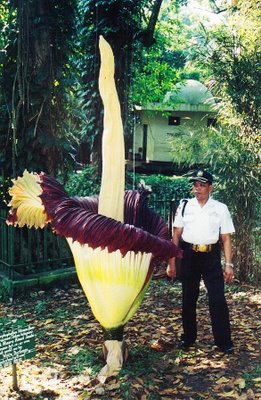
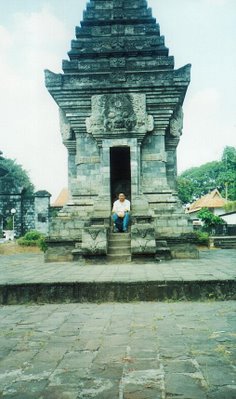
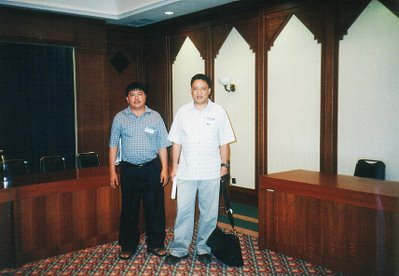
Apparently, Jakarta is a non-noodle eating city. But its tasty variations of nasi goreng at Pecenong Road, Nasi Goreng Kebun Sirih, or Pulan Dua were filling. We moved around a lot and never really have a chance of enjoying the city. There was of course that one-day sojourn at Bogor where we gawked at the world’s biggest and stinkiest flower and snacked on durian at a roadside fruit stand. I also had a photo taken at a Balinese temple replica at the Taman Mini Indonesia where a miniature of the fabled Burubudur is also on display. The highlight perhaps is when I was showed the prayer room of Gus Dur --- former Indonesian president who was succeeded by Megawatti Sukarnoputri --- at the Fatayat Nahdladtul ‘Ulama.
Photos (from top to bottom):
1) A dinner of noodles in Singapore;
2) Precy surrounded by violet orchid flowers at the Singapore Botanical Garden;
3) The yellow orchid flowers of Singapore’s Copthorne Orchid Hotel;
4) Rafflesia or Bunga Bangkay (very Filipino words which literally means “fruit of the dead") the biggest flower in the world;
5) A Balinese temple replica; and
6) With Eboy at Gus Dur’s prayer room.
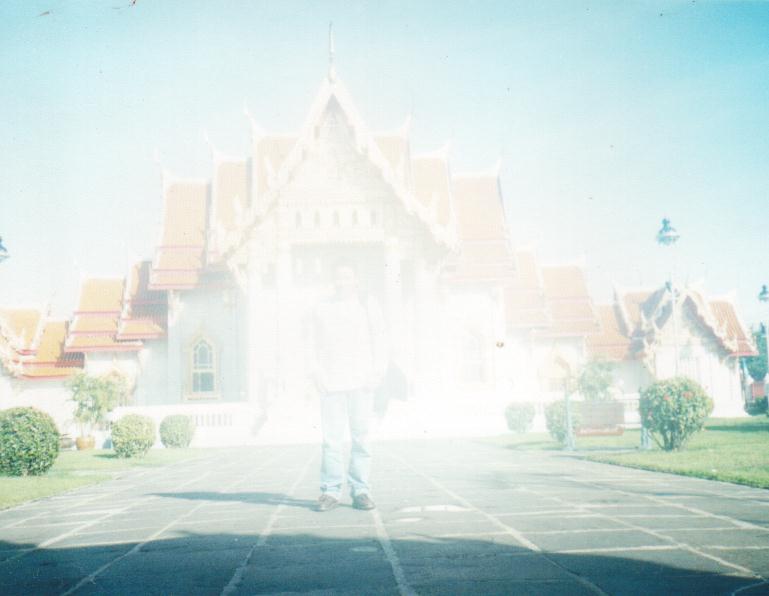
My first trip outside the Philippines is to Thailand where I attended a training program on family planning advocacy at the Asian Center from November 25 until December 14 of 2002. I was part of a group that included our company’s fabled “Packard Boys”. We stayed at the Somerset Hotel along Bangkok’s Sukhumvit area and on our first night, Oyet came and treated me to dinner in Simlon Road then to a hurried night tour of the infamous Patpong area, the Flower Market, and Chinatown.
During this time, I have not yet transformed into a churchopile but it seems that places of deity worship have a special link to me because I am always drawn to churches, temples and shrines. Perhaps it was the imprint of these churches near the houses we stayed and the schools we went, or the blood of the fraile in Miguel Tomas’ hands, or Amang Lakay’s Babaylan and his conversion as a Sabadista, or the miracles of my childhood.
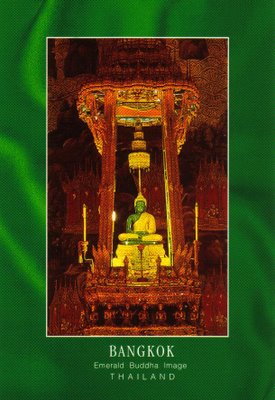
Buddhism is Thailand’s religion and the shrines and wats (i.e. temples) that dotted its landscape enthralled me with their beauty and mystique. From there on, I always made it a point to bow and do my wai every time I passed one although I did not really understand then the symbol and significance of such act. In Bangkok, I was able to visit the holiest Buddhist temple in Thailand --- Wat Phra Keo or more popularly known as the Temple of the Emerald Buddha that was built by King Rama I in 1782 when he established Ratanakosin as his kingdom’s capital.

The Emerald Buddha housed inside Wat Phra Keo was actually carved from a large piece of jade discovered in 1434 inside a chedi that was shattered open by lightning. Its green cover was discovered later after the image’s stucco covering was removed. It was moved several times to Chiang Mai but somehow, the image always ended up in Lampang (shades of Badoc and Sinait). It was not until 1468 that the image finally relented to be installed in Chiang Mai. In 1552, the image was brought to Luang Prabang in Laos by King Chaichetta who was Chiang Mai’s Lao-born ruler. When the Lao capital was moved to Vientiane in 1564, the image also went there to protect it from the invading Burmese army. King Rama I brought it back to Thailand after he captured Vientiane in 1778, and had it installed at the Wat Phra Keo in 1784. Since then, the temple underwent several restorations: in 1831 by King Rama III, in 1856 by King Rama IV, in 1903 by King Rama V after it was damaged by a fire, in 1932 by King Rama VII, and most recently in 1982 by King Rama IX who is more popularly known as King Bhumibol.
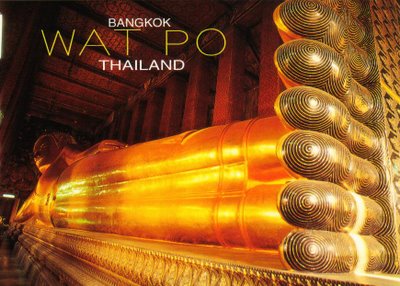
 Another major Buddhist temple near Wat Phra Keo is Wat Pho that was once the Wat Phodaram of the Ayudha period. It was restored by King Rama I in 1788 and houses what is said to be the biggest and most beautiful Reclining Buddha image in Thailand. The temple is regarded as the university where the traditional Thai massage originated and is still being taught. It underwent restoration during the reigns of King Rama III and King Rama IX.

 Our group also spent a week in Chiang Mai where I was able to visit the Thai Buddhists’ second holiest site of Wat Doi Suthep perched high on a mountain. The temple can be reached through a stair of perhaps a thousands steps or an elevator for the physically challenged. There, I had my fortune stick, paid my respects at the main Buddha image where a monk tied a string on my wrist for good luck, rang the conical bells for my wishes to come true, and kissed the clouds of Chiang Mai.

During one field visit, I also dropped by Wat Suan Dok where members of Chiang Mai’s royal family are interred. There is a Buddhist monastery nearby with boy monks. My soul flowed in the hypnotic rhythms of their Buddhist chants, and I never felt so serene in my life.
 Aside from churches, noodles maintain a special affinity with me. I had plenty of these in Thailand --- almost everyday --- and my co-trainees teased me if I don’t ever get tired of it. I forget the many Thai noodle dishes that I gorged on mainly because the names are really quite difficult to pronounce and remember, and because I don’t yet have plans of blogging about them later.
PHOTOS (from top to bottom):
1) Bangkok’s Wat Phra Keo
2) Postcard of Wat Phra Keo’s Emerald Buddha
3) Bankok’s Wat Pho
4) Postcard of Wat Pho’s Reclining Buddha
5) Chiang Mai’s Wat Doi Suthep
6) Chiang Mai’s Wat Suan Dok