August 23 (Saturday)
Des Moines was home. I like the city falling asleep at 7:30 pm and waking up early the next morning. I love LaVon Griffieon’s Century Farm and its apple trees and farms animals and barns. And it was certainly fun nuking ambrosia corn in Akash’s room at the Fort Des Moines Hotel, the still lingering sweet taste flashing back images of a barbecue and my first Fil-Ams who packed me a dinner of Americanized biko and huge broiled sausages that stretched to brunch, and the s’mores and chocolate melting with the sun.
These memories I stirred on a glass of tomato juice during the flight to Denver (I learned late that beverages were indeed served free on American domestic flights). After almost 2 hours, we arrived at an airport bursting with bricbrats of the incoming Democratic National Convention. I killed time window shopping Obama shirts and walking both ends of the airport 10 times in a vain attempt to have at least a glimpse of the Rocky Mountains. We hooked up with the St. Louis Group. A plump lady made a final boarding call. And then Portland.

August 24 (Sunday)
The weather is supposed to be fair for our North Oregon Coast Tour and it was that up to the pee stop at the Camp 18 Restaurant where I brought a sweater for Bulan. Then it rained as we tried to bird watch along Ecola State Park’s Pacific coast and hike through the Douglas fir forest of the Oswald West State Park. It went on at Cannon Beach where I tried to ease its dreariness with a bowl of hot thick clam chowder and a boat of seafood salad and smoked mussels. I walked around, my camera bulging and protected inside my fortunately waterproof jacket, trying to kill time with an over sized cup of Diet Coke from lunch. I was almost a loser until the wine and free cheese at the Tillamook Blue Heron Cheese Factory later in the afternoon helped ebb the iciness of the day.

I had a hot shower and the cozy warm bed back at the hotel. I slept soundly, dreaming of the pages of a brown hardbound book of a long time ago in a distant place called Almaguer. It tells the story of Lewis and Clark and their Indian guide as they trek the Oregon Territory to the Pacific.
August 25, (Monday)
It was our first day of meetings and we were in-house for a morning briefing about the Marriot Residence Inn (where we were staying) being green, and a formal welcome from our local host --- the World Affairs Council of Oregon. The St. Louis and Minneapolis teams also shared their experiences and ours too in Des Moines.
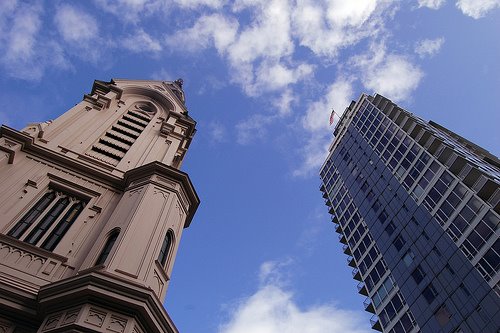
After lunch, we were toured in Portland’s Pearl District via the streetcars of the city’s Trimet Total Transit System. It was about the city being green, encouraging clean mass transport, and transforming Brownfields. Then I raced like hell to catch the hotel’s free football game dinner, and then to Clay Street where I battled to shoot 3 churches in the fading daylight and impending rain.
August 26 (Tuesday)
And then no rain. Just the clear blue sky as we leisurely cruised the Historic Columbia River Highway. I thought it would be a great day for photography.
The downside was shooting under time pressure with only 20-30 minutes to assess each site, select the subjects, adjust camera settings, click, and buy mementos. Add to that the frequent requests for the mandatory souvenir photos by my colleagues. So I was off like mad on the first stop at Crown Point, dancing around Vista House and running up and down its balcony while snatching a couple of souvenir key chains, drinking the loveliness of the Columbia River Gorge, and clicking like there’s no tomorrow. The majestic Multnomah Falls was more difficult with its steep 10-minute hike from the viewing deck to the Benson Footbridge. But I had my photos with some time to spare to buy a shirt for the wife back home and a ranger’s vest for Balong.

Hood River was a working lunch with my first American Indians. The older chief spoke nonchalantly as if resigned to his fate. The younger one was solemn and electrifying in his narration of their battles and hopes that I thought was laced with frustration. He held us in rapt attention and carressed our souls with a melancholic Indian prayer. I was reminded of the Aeta in his tribal regalia during the first Development Innovation Marketplace showcase at the SM Mega-mall in Manila --- a reluctant part of the exhibit shaking from the coldness of a controlled environment.
The day’s finale was Timberline Lodge within a shout of the glacier-covered peak of Mt. Hood. And I --- the sometimes too time conscious and obedient I --- still have nightmares on missing the walk to a snow patch. What I would give to turn back time and be part of the late-for-boarding but deliriously happy photo of Africans and Asians rolling snowballs captured by Akash’s camera.
August 27 (Wednesday)
Fatigue is creeping in from the hustle and bustle of the last 3 weeks. It’s not yet there but damned too near for comfort. It was good that a pretty and sweet talking Asian-American did the presentation of the Portland Office of Sustainable Development. She’s great and she’s hot! The brief respite at the Portland International Rose Test Gardens and a side trip to Lloyds Center Mall also helped. I did have plans to buy a Nikkor telephoto lens for my camera but the $500+ price tag is just too expensive. There was a $150 Sigma version but it was out of stock and will be available on the day I will be flying back home. Tough luck.

I struggled through the afternoon sessions --- mentally asleep but physically awake at the World Forest Institute and nearly boycotting a tour of the Portland Center Stages New Armory Theater. At the hotel, I grabbed a plate of hotdogs, burgers, and tortillas on the way up to my suite but fell asleep midway into my dinner and Democratic VP nominee Sen. Joe Biden’s speech.
August 28 (Thursday)
Our last day. I shared my impressions (understanding the American way of life beyond the text books and foreign policy), gave my evaluation (learning everything in Washington DC, the slowness of the Big Easy, professional fulfillment in Des Moines, Portland being the best of them all), received my certificate (and shot each of my colleagues having theirs), and posed for a group photo. I said my good byes to Safi (Afghanistan), Sabrina (Argentina), Nili (Israel), Rhova (Kenya), Guadalupe (Mexico), Sasha (Montenegro), Sana (Morocco), Sokhna (Senegal), Steven (South Africa), Urwa (Syria), Ibi (Uganda) and Mutaz (Palestine) who will be leaving earlier and might not be seeing again. I washed my dirty clothes, threw unwanted excess baggage to make the weight limit, and performed the sacred art of packing. I treated myself to a big Mediterranean lunch and did a reluctant farewell walk down South Waterfront Walk to the Old Town and Pearl District, which brought me to a last minute surprise of a neighborhood of churches along the SW Park area. It was perhaps a parting gift for my wonderful American adventure.

August 29 (Friday)
I met Neera (Nepal), Akash (India), Jonathan (Liberia), and Israr (Pakistan) at the hotel lobby for our trip to the airport. We hugged farewells to Rodrigo (Colombia) and Uche (Nigeria). They will be leaving on later flights.
My last good bye was to Greg, a third of our English Language Officers with Ellen and Bob. He spent some time in the Philippines and the most casual and friendly of the three. He said he would be looking over my photos and blog page.
The sun did not set through out the long haul to Narita.
August 30 (Saturday)
Back home finally. I told my wife to fetch me at the airport and spend the night at the Diamond Hotel where I was billeted by the US Embassy. The kids and karruba can wait. We have almost a month to catch up.
Des Moines was home. I like the city falling asleep at 7:30 pm and waking up early the next morning. I love LaVon Griffieon’s Century Farm and its apple trees and farms animals and barns. And it was certainly fun nuking ambrosia corn in Akash’s room at the Fort Des Moines Hotel, the still lingering sweet taste flashing back images of a barbecue and my first Fil-Ams who packed me a dinner of Americanized biko and huge broiled sausages that stretched to brunch, and the s’mores and chocolate melting with the sun.
These memories I stirred on a glass of tomato juice during the flight to Denver (I learned late that beverages were indeed served free on American domestic flights). After almost 2 hours, we arrived at an airport bursting with bricbrats of the incoming Democratic National Convention. I killed time window shopping Obama shirts and walking both ends of the airport 10 times in a vain attempt to have at least a glimpse of the Rocky Mountains. We hooked up with the St. Louis Group. A plump lady made a final boarding call. And then Portland.

August 24 (Sunday)
The weather is supposed to be fair for our North Oregon Coast Tour and it was that up to the pee stop at the Camp 18 Restaurant where I brought a sweater for Bulan. Then it rained as we tried to bird watch along Ecola State Park’s Pacific coast and hike through the Douglas fir forest of the Oswald West State Park. It went on at Cannon Beach where I tried to ease its dreariness with a bowl of hot thick clam chowder and a boat of seafood salad and smoked mussels. I walked around, my camera bulging and protected inside my fortunately waterproof jacket, trying to kill time with an over sized cup of Diet Coke from lunch. I was almost a loser until the wine and free cheese at the Tillamook Blue Heron Cheese Factory later in the afternoon helped ebb the iciness of the day.

I had a hot shower and the cozy warm bed back at the hotel. I slept soundly, dreaming of the pages of a brown hardbound book of a long time ago in a distant place called Almaguer. It tells the story of Lewis and Clark and their Indian guide as they trek the Oregon Territory to the Pacific.
August 25, (Monday)
It was our first day of meetings and we were in-house for a morning briefing about the Marriot Residence Inn (where we were staying) being green, and a formal welcome from our local host --- the World Affairs Council of Oregon. The St. Louis and Minneapolis teams also shared their experiences and ours too in Des Moines.
After lunch, we were toured in Portland’s Pearl District via the streetcars of the city’s Trimet Total Transit System. It was about the city being green, encouraging clean mass transport, and transforming Brownfields. Then I raced like hell to catch the hotel’s free football game dinner, and then to Clay Street where I battled to shoot 3 churches in the fading daylight and impending rain.

August 26 (Tuesday)
And then no rain. Just the clear blue sky as we leisurely cruised the Historic Columbia River Highway. I thought it would be a great day for photography.
The downside was shooting under time pressure with only 20-30 minutes to assess each site, select the subjects, adjust camera settings, click, and buy mementos. Add to that the frequent requests for the mandatory souvenir photos by my colleagues. So I was off like mad on the first stop at Crown Point, dancing around Vista House and running up and down its balcony while snatching a couple of souvenir key chains, drinking the loveliness of the Columbia River Gorge, and clicking like there’s no tomorrow. The majestic Multnomah Falls was more difficult with its steep 10-minute hike from the viewing deck to the Benson Footbridge. But I had my photos with some time to spare to buy a shirt for the wife back home and a ranger’s vest for Balong.

Hood River was a working lunch with my first American Indians. The older chief spoke nonchalantly as if resigned to his fate. The younger one was solemn and electrifying in his narration of their battles and hopes that I thought was laced with frustration. He held us in rapt attention and carressed our souls with a melancholic Indian prayer. I was reminded of the Aeta in his tribal regalia during the first Development Innovation Marketplace showcase at the SM Mega-mall in Manila --- a reluctant part of the exhibit shaking from the coldness of a controlled environment.
The day’s finale was Timberline Lodge within a shout of the glacier-covered peak of Mt. Hood. And I --- the sometimes too time conscious and obedient I --- still have nightmares on missing the walk to a snow patch. What I would give to turn back time and be part of the late-for-boarding but deliriously happy photo of Africans and Asians rolling snowballs captured by Akash’s camera.
August 27 (Wednesday)
Fatigue is creeping in from the hustle and bustle of the last 3 weeks. It’s not yet there but damned too near for comfort. It was good that a pretty and sweet talking Asian-American did the presentation of the Portland Office of Sustainable Development. She’s great and she’s hot! The brief respite at the Portland International Rose Test Gardens and a side trip to Lloyds Center Mall also helped. I did have plans to buy a Nikkor telephoto lens for my camera but the $500+ price tag is just too expensive. There was a $150 Sigma version but it was out of stock and will be available on the day I will be flying back home. Tough luck.

I struggled through the afternoon sessions --- mentally asleep but physically awake at the World Forest Institute and nearly boycotting a tour of the Portland Center Stages New Armory Theater. At the hotel, I grabbed a plate of hotdogs, burgers, and tortillas on the way up to my suite but fell asleep midway into my dinner and Democratic VP nominee Sen. Joe Biden’s speech.
August 28 (Thursday)
Our last day. I shared my impressions (understanding the American way of life beyond the text books and foreign policy), gave my evaluation (learning everything in Washington DC, the slowness of the Big Easy, professional fulfillment in Des Moines, Portland being the best of them all), received my certificate (and shot each of my colleagues having theirs), and posed for a group photo. I said my good byes to Safi (Afghanistan), Sabrina (Argentina), Nili (Israel), Rhova (Kenya), Guadalupe (Mexico), Sasha (Montenegro), Sana (Morocco), Sokhna (Senegal), Steven (South Africa), Urwa (Syria), Ibi (Uganda) and Mutaz (Palestine) who will be leaving earlier and might not be seeing again. I washed my dirty clothes, threw unwanted excess baggage to make the weight limit, and performed the sacred art of packing. I treated myself to a big Mediterranean lunch and did a reluctant farewell walk down South Waterfront Walk to the Old Town and Pearl District, which brought me to a last minute surprise of a neighborhood of churches along the SW Park area. It was perhaps a parting gift for my wonderful American adventure.

August 29 (Friday)
I met Neera (Nepal), Akash (India), Jonathan (Liberia), and Israr (Pakistan) at the hotel lobby for our trip to the airport. We hugged farewells to Rodrigo (Colombia) and Uche (Nigeria). They will be leaving on later flights.
My last good bye was to Greg, a third of our English Language Officers with Ellen and Bob. He spent some time in the Philippines and the most casual and friendly of the three. He said he would be looking over my photos and blog page.
The sun did not set through out the long haul to Narita.
August 30 (Saturday)
Back home finally. I told my wife to fetch me at the airport and spend the night at the Diamond Hotel where I was billeted by the US Embassy. The kids and karruba can wait. We have almost a month to catch up.


