Wednesday, October 04, 2006

THE OTHER CHURCH

One of the guerilla leaders who frequently visited Amang Lakay during the war is Apong Ino, Miguel’s son and Amang Lakay’s capidua. It was Apong Ino who brought the guerillas to Amang Lakay’s house. One day, a plague of measles, small pox and typhoid fever visited Almaguer. Many children got terribly sick including Auntie Ibang. All the doctors are in the war and all the medicines are used to treat the war’s wounded so Inang Baket can only boil dangla and other leaves to ease Auntie Ibang’s pain and fever. One night, Apong Ino who is a Sabadista came to Amang Lakay’s house with a group of guerillas for their usual supper and he learned of Auntie Ibang’s condition. He asked Inang Baket to boil some water then wiped Auntie Ibang with it with a labacara. This healing technique is called pamenteysyon that Apong Ino learned from the Americanos. Auntie Ibang got well and in gratitude to Apong Ino, Amang Lakay and his whole family converted into Sabadistas.

That was how Precy, who was born before the war came to Almaguer, got her religion. A nurse called Loleng who would later become a lieutenant during the war attended to her birth and requested Amang Lakay to name the child Eufrocina. She is Amang Lakay and Inang Baket’s second child to survive. Eufrocina or Precy graduated from high school in NELA in 1957 where she was baptized as an official Sabadista by Pastor Trofino Aliga. She enrolled at Saint Mary’s College in Bayombong but it will take her thirteen long years to finish college, having to work in between so she can support her studies.


While trying to get a college degree, Precy met Kid Buntal during a Sabadista crusade in Bayombong. Kid Buntal is a member of Bambang’s copycat Pitong Gatang who never go to church, and with a lifestyle that go against the doctrine of the Sabadistas. How he got to the crusade was never told but perhaps it was the same gasat that brought Lakay Burik and Baket Leoncia, and Amang Lakay and Inang Baket together. Precy was so scared of him that she would not even shake hands after they were introduced by Pastor Geronimo Calangan. But Kid Buntal persisted and began attending the Sabadistas’ bible studies. He cut his hair and was on his way to be baptized in the dacquel nga carayan when a jeep rammed into the calesa he was riding, throwing him into the air and fracturing his leg when he landed.


They got married one year after Kid Buntal’s leg healed and was finally baptized. He was accompanied by Uncle Doming and Lolo Pulis during his pamamanhikan. It was a grand wedding on 21 April 1969 at the Bambang Seventh-day Adventist Church with 15 pairs of ninongs and ninangs. The wedding ceremony was administered by the president of the Sabadistas’ Northern Luzon Mission himself, Pastor Jeremias Medina, which is equivalent to having the bishop. Two cows were butchered for the grand padaya at Auntie Angeling’s big house. One year later and pregnant with her first child, Precy finally graduated from college with a bachelor’s degree in elementary education. Kid Buntal supported her last year in college.


Precy had ambitions and was the most socially active among her siblings. In her lifetime, she served as a president of SAYBC (Almaguer’s youth association where the barrio’s fabled basketball team was named), became the youngest elected director of the Bambang Senior Citizens Association (it was she who introduced the song “Never Grow Old” that became the official song of Nueva Vizcaya’s senior citizens), worked as a domestic helper in Singapore, sidelined as a sales agent and a literature evangelist, and was appointed as Almaguer’s barangay secretary. That is on top of her being a missionary teacher.

As a missionary teacher, Precy will be assigned to different places where she and her family stayed in houses besides schools and churches. The earliest of these is the house in Solano, Nueva Vizcaya that is squeezed between the school and the rear of the church. There is a place nearby where big white flowers grow and where Precy’s two young sons loved to go. Precy was next assigned in Naguillian, Isabela and by this time, Kid Buntal started working as a literature evangelist. They stayed in a house a stone’s throw away from the school and the church. Every Sunday, their two sons will walk through endless swaths of tobacco fields to go swimming to a river which is actually the downstream part of the dacquel nga carayan in Almaguer. They next resided in Mapandan, Pangasinan in the other half of a concrete duplex house beside the church in front of the school; then Paniqui, Tarlac where they rented the upper part of a house after the school and beside the church.


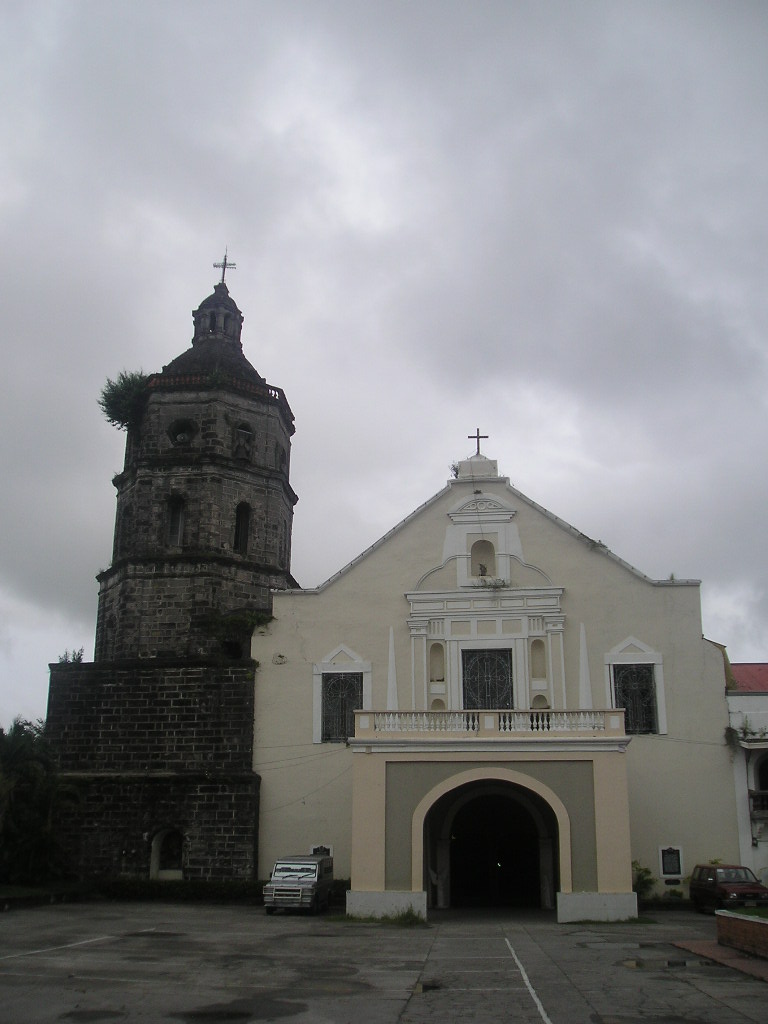
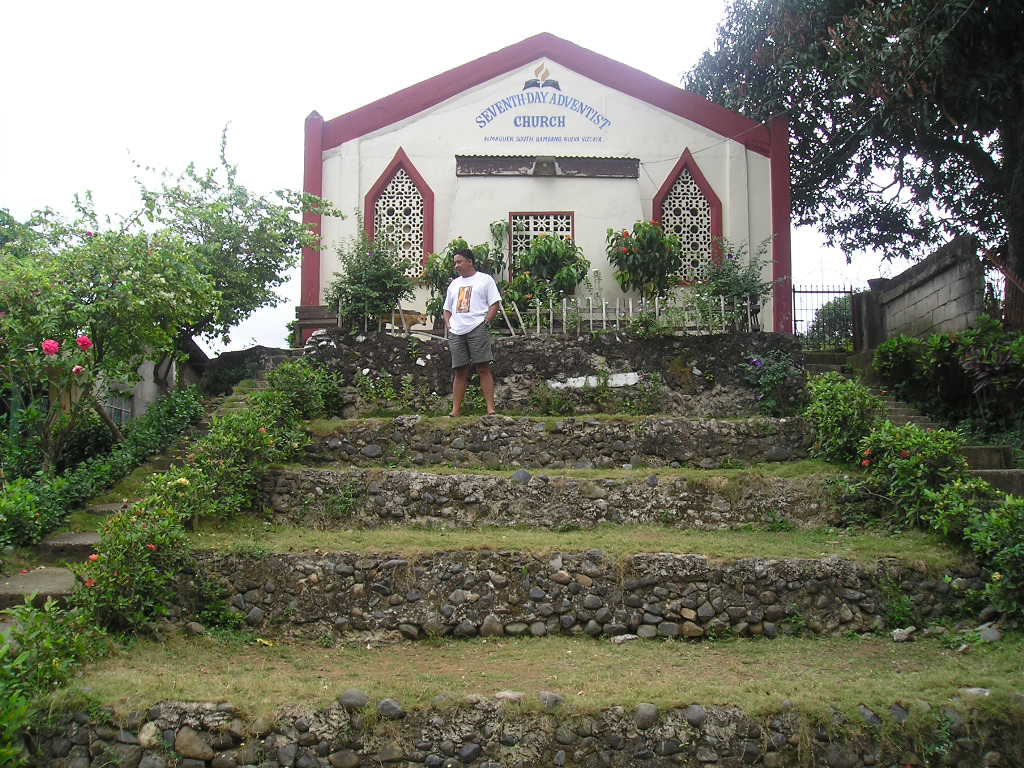
In between these movements is Almaguer where Precy was assigned in 1978. They stayed at a dormitory behind the school and beside the church. It was her children’s first time to see the frightening Apong Ino, wearing black pants and a white sando, sitting in his rocking chair at the balcony of his big house on top of a hill beside the church. The church and school actually stands on a property that was donated by Miguel Tomas. Sometime ago, I came across a black and white photo of Kid Buntal standing along one of the terraces in front of the church during the funeral of Apong Vito --- Miguel Tomas’ wife and Apong Ino’s mother. I was fortunate to have been able to make a modern reproduction of that scene before the church was given a facelift courtesy of a donation from one of Apong Ino’s children who’s based in the United States, and just after the big flood of 2005.
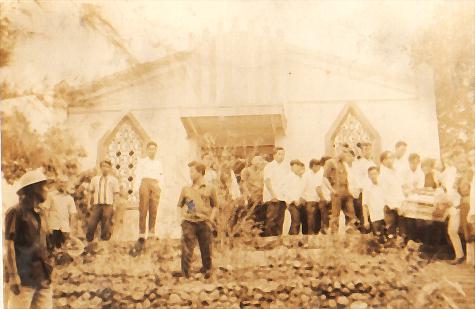

Kid Buntal (standing in the middle) at the Almaguer SDA church during the funeral of Apong Vito

Kid Buntal's son in the same church 35 years later
Angels will figure prominently in Precy and Kid Buntal’s lives during these early years. Their eldest child Abet will have his first encounter with them when they moved to Lolo Porong’s farm in the barrio of Sto. Domingo in Bambang. Abet followed a flock of ducks into a deep irrigation canal and at his age, he was supposed to be swept away by the swift current and drown. But Precy said she saw Abet in the middle of the rushing water holding on to something that looked like an angel. In another incident, Uncle Doming found the second child Eric hanging with his fingertips from the balcony of the big house in Bambang. He was supposed to fall but Uncle Doming swear he saw an angel holding him. A year later, the third child Sherrie Lyn was born. She will live for three days and died on Abet’s birthday. Precy told her two sons that their sister went to heaven and became an angel.

The angels in Naguillian came when a boy named Hope who died in the mountains was brought to the Sabadista church for a one night wake. A slide presentation about the Bible was held and the pastor told Abet and Eric that Hope is now one of God’s angels. In Mapandan, the angels come on Sundays when Precy and Kid Buntal will leave the children to sell books. When they come back, they always bring pasalubongs for the children who have been angels while they are away. The angels in Paniqui are more surreal. There is a house beside the school where people come to get cured. They brought lots of eggs which the healer breaks and places in glasses of water beside a life-size white statue of the Virgin Mary. The healer will look at the eggs and write on a piece of paper words that only she can understand. Then she will wipe holy water on the sick person. And they got healed. The landlord said the lady is guided by angels.

Back in Almaguer, Kid Buntal will be reunited with his surviving Pitong Gatang buddies and will always go home late and drunk. On occasions like this, Precy will ask her children to pray with her for God to send his angels to guide their father home safely. On Abet’s 6th grade, Precy quit her teaching job. This time, they stayed in Purok Sonsona in a hut beside the two-story wooden house Auntie Angeling bought when she sold the big house in Bambang. It was their first time to live away from schools and churches. One night, Kid Buntal was brought home by a jeep, all his front teeth gone and a part of his lips hanging grotesquely from his chin. The angels are gone.

PHOTOS (top to bottom):
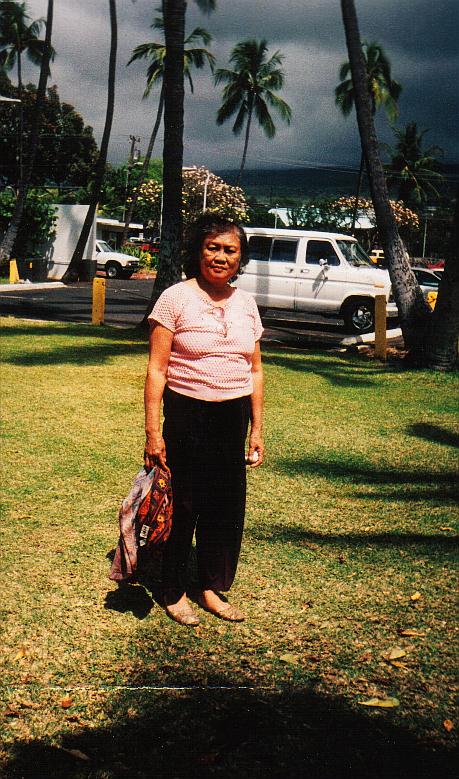
(1-2) Young Precy and friends; (3) Precy as a college student at the Saint Mary's College in Bayombong, Nueva Vizcaya; (4) The wedding of Precy and Kid Buntal in Bambang, Nueva Vizcaya; (5) The church front in Solano, Nueva Vizcaya circa 1974 and (6) circa 2005; (7) Naguillian, Isabela circa 1977 and (8) circa 2005; (9) Kid Buntal during the funeral of Apong Vito in Almaguer (10) and his son standing in the same place 35 years later.

Wednesday, September 27, 2006

THE TAGALOG AND KAPAMPANGAN REPUBLIC


Aside from the art of guisa and religion, one of the greatest Spanish contributions to the Filipinos is the concept of nationhood. Before the Philippine Revolution of 1898, most rebellions against the Spanish colonist were confined on reasons of personal injustices (like the refusal of a priest to bless Dagohoy’s dead brother that ignited the longest running insurgency against the colonial government), excessive colonial policies (like the Wine Monopoly which triggered the Basi Revolt), and religious fervor (like the cause of Hermano Pule). The concept of independence began to take shape only in the years leading into 1898 but even this is within the parameter of a Tagalog kingdom or republic. The transition into the idea of nationhood was espoused and weaned by a principalia that have been leveraging with the colonialist government ever since. This principalia is dominated by the Tagalogs and Kapampangans who eventually steered the Philippine Revolution of 1898 that started our march into nationhood. This fact is stated in the Philippine flag where the 8 rays of the sun honors the first provinces to revolt against Spain. They are all Tagalog and Kapampangan provinces.

The epitome of these dominant ethno-linguistic groups are the provinces of Bulacan (synonymous with the Tagalogs) and Pampanga (synonymous with the Kapampangans). Aside from a rich political history, these provinces are also teeming with ecclesiastical structures whose sheer number is too much for a single article. The story of my visita iglesia in these provinces were therefore divided into 5 parts: McArthur’s Church(es) which is about colonial churches along the McArthur Highway and have been previously blogged, the colonial churches along the Manila Bay coastal area, Pampanga colonial churches along the Angeles City-Dinalupihan and the Gapan-San Fernando-Olongapo Roads, and those in Bulacan along the National Highway and the province’s interior. This article is about my visita to the coastal churches.

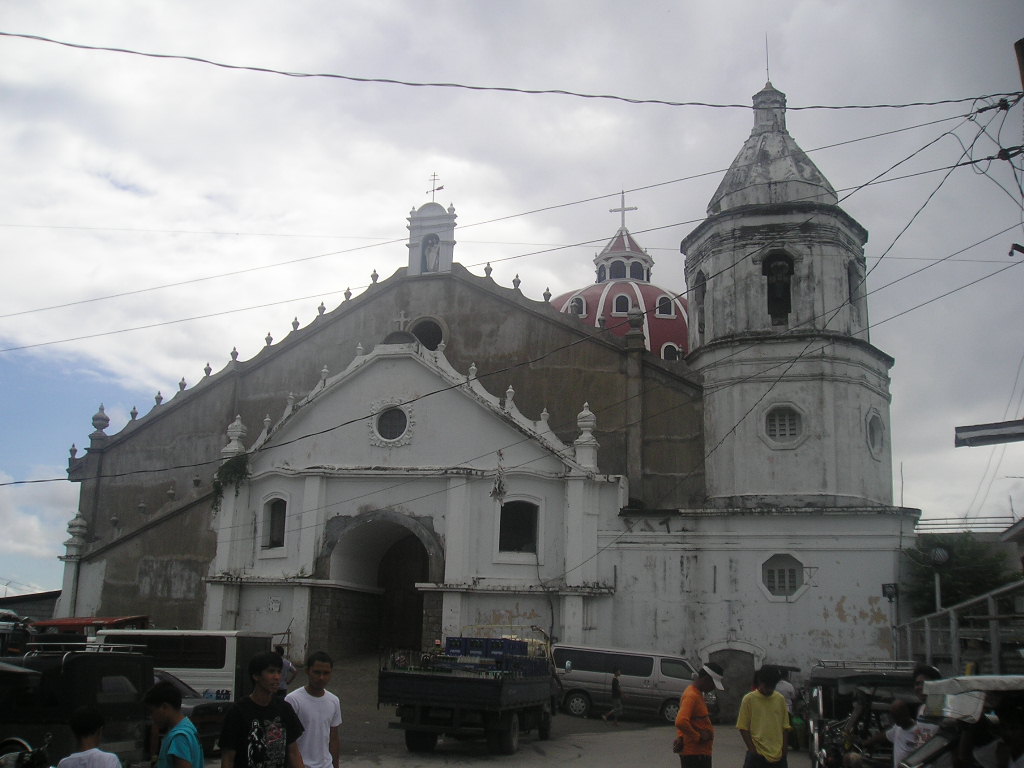
The first stop will be Bacolor’s church of Nuestra Senora del Rosario along the road to Olongapo that was half-buried by lahar from Mt. Pinatubo. The Bacolot or Vacolot of old meant “surrounded by land” in Kapampangan. It was established in 1576 by a landlord named Guillermo Manabat and accepted by the Augustinians as a mission on the same year. There are no records on who built the first parochial buildings although it was cited that a church was rebuilt and damaged in the earthquake of 1645. The present church might have been built under the supervision of Fr. Jose Coronel (OSA) from 1617 until 1629. During the British invasion, the church and convent served as a seat of Governor-General Simon de Anda’s government in exile and was later ransacked by the invaders. The church was restored by Fr. Manuel Diaz (OSA) in 1852 and was repaired after suffering damages from the 1880 earthquake.


A left turn from the Gapan-San Fernando-Olongapo Road will lead to the town of Lubao that was accepted by the Augustinians as a visita of Tondo in 1572, and served as their missionary center for the Pampanga and Bulacan provinces. Fr. Juan Gallegos (OSA) probably built the first parochial buildings in 1575 with light materials at Sitio Sapang Pare. Fr. Jose Coronel (OSA) started the construction of another church in the current site probably in 1602. Fr. Antonio Herrera (OSA) initiated building what is probably the present church of San Agustin in 1614 that was finished in 1638. An earthquake damaged the church in 1645 and was probably repaired. In 1729, Fr. Vicente Ibarra (OSA) supervised the building of a convent that was once the most beautiful in the whole Philippines. Repairs and improvements to the church were initiated from 1877 until 1893. It was occupied by Katipuneros in 1898 and used as a hospital by the Americans in 1899. It was damaged by Japanese shelling during World War II and repaired under the supervision of Fr. Melencio Garcia and other Filipino priests from 1949 until 1962. President Diosdado Macapagal was baptized in the church in 1910 by Fr. Francisco dela Banda.


My next stop from Lubao is Sasmuan --- the town once scandalously known as Sexmoan which is a hispanized form of the Kapampangan word sasmoan meaning “to flock”. It was founded as a pueblo and established as an Augustinian mission in 1590. Fr. Jose Duque (OSA) probably built the first parochial buildings from 1659 to 1677. The rising waters of the river washed these away and new buildings were probably erected in the early 18th century. The present church of Santa Lucia was built in 1735 and was restored and improved from 1884 until 1898. The church has lost much of its original design after being recently enlarged.


A short drive from Sasmuan is Guagua, a town whose name was derived from the Kapampangan word uaua that means “the mouth of the river”. The Augustinians built the first church from light materials after accepting it as a mission in 1590. New parochial buildings were reported to be being constructed in 1641. Fr. Jose Duque (OSA) --- a major participant in the pacification campaign of Pampanga after its revolt of 1660 --- initiated the construction of what is probably the present church of La Imaculada Concepcion from 1661 until 1684 that was said to be as big and beautiful as the San Agustin church in Manila. Further improvements were later made from 1862 until 1886. The church once had the best organ in the whole of Pampanga.


National Heritage: Church Art at its Best


The Augustinians accepted Betis as a visita of Tondo in 1572. Fr. Fernando Pinto (OSA) later had a church built from light materials from 1596 until 1604,. A stronger structure was probably constructed under the supervision of Fr. Jose dela Cruz (OSA) from 1665 until 1687. The present church of Santiago Apostol was built early in the 18th century and, because of the lack of laborers, was only completed in 1770. It was probably repaired in 1789 and again in 1855. Fr. Manuel Camanes (OSA) had the church and convent repaired from 1868 until 1898. He also introduced other improvements like digging the well beside the church that still exists today, and the probable installation of the artistically painted ceilings. The church is acknowledged to have the most beautiful retablo in the whole province of Pampanga. Betis today is a barrio of Guagua and its church has been declared as a national heritage site by the National Commission on Culture and Arts.


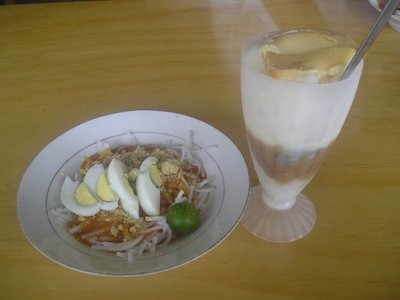
From Guagua, the next colonial churches along Pampanga’s coast of Manila Bay are Minalin and Macabebe which have been previously blogged. And along the way, a refreshment of halo-halo and pancit malabon at Razon’s is a must. The pancit malabon is simple in both ingredients and presentation: white spaghetti-like noodles topped with a thick sauce, garnished with chicharon bits and slices of hard-boiled eggs, and spiked with a head of calamansi. Its lot different from the pancit malabon I usually have but perhaps better in taste. It goes well with the famous halo-halo that’s made up of fine-shaved ice, soft sweetened bananas, lots of milk, and 2 slices of creamy leche flan.


In Bulacan, the entry point to the province’s coastal towns is the historic city of Malolos that Fr. Diego Ordonez (OSA) first evangelized. He probably baptized the town’s first Christians in the old town of Kanalate which is now the northern part of Malolos. The Augustinians later accepted Malolos as a mission in 1589 and built the first parochial buildings in 1591. Fr. Roque Barrionueva (OSA) initiated building a larger church in 1691 that was probably finished in 1707. This was again probably damaged and was rebuilt under the successive supervisions of Fr. Fernando Sanchez (OSA), Fr. Fr. Juan de Meseguer (OSA), and Fr. Manuel Baceta (OSA) from 1734 until 1744. Fire destroyed both church and convent --- including the 18th century retablo --- in 1813 and were rebuilt in 1819 under the supervision of Fr. Melchor Fernandez (OSA). This is the present church of La Imaculada Concepcion that was consecrated in 1826. Both church and convent were again damaged in the earthquake of 1863 and were restored from 1859 until 1872. The Katipuneros burned the church and the newly restored convent in 1898. Since then, both buildings underwent restoration that lasted until 1976. Malolos is a place rich in history. It was one of Governor General Simon de Anda’s seats of government during the 1762 British invasion, and later of Gen. Emilio Aguinaldo who held office in the convent as president of the First Philippine Republic from 1898 to 1899. At the front of the church is what had been called the Kalayaan tree: a mute witness to the unfolding of these great events.


The more famous colonial church in Malolos is of course the nearby Barasoain Church which is actually the Church of our Lady of Mt. Carmel. Barasoain was originally established as a visita of Malolos. In 1816, Fr. Melchor Fernandez (OSA) built a small ermita that served as the temporary church. Fr. Francisco Royo (OSA) later had a stone church built from 1871 to 1878. This was burned down and the cemetery chapel became the temporary church until it was also destroyed during the 1880 earthquake. A nipa and bamboo church was built but this was razed by fire in 1884. The present church was built during the time of Fr. Juan Giron (OSA) in 1885, and the bell tower during Fr. Martin Arconada’s administration in 1889 who also had the convent restored. The convent served as the seat of General Aguinaldo’s revolutionary government who promulgated the Malolos Constitution. General Aguinaldo also established the Literario-Cientifica Universidad de Filipinas in the same place in 1898. The church and convent were declared as a national landmarks in 1973.


The way to Hagonoy from Malolos is through narrow roads passing through the town of Paombong and various scenes of fishing life. Agonoy already existed in 1571, ruled by a chieftain called Salpingan who fought Miguel Lopez de Legazpi’s soldiers during their raid on Manila. It became a visita of Calumpit in 1581. Fr. Diego Ordonez de Vivar (OSA) had an early church made of nipa and bamboo built in a barrio called Quinabalon which is now the present barrio of Sta. Monica. Fr. Juan Albarran (OSA) supervised the building of a stone church from 1731 to 1734 that was razed by fire in 1748. Fr. Eusebio Polo (OSA) had another church built in 1749 that was completed in 1752 but was probably destroyed because from 1815 to 1836, Fr. Juan Coronado (OSA) had another stone church built. This was damaged by fire in 1856 and replaced by a bigger church --- probably the present one and dedicated to Santiago Apostol --- that was built in 1862 under the supervision of Fr. Manuel Alvarez (OSA). The church was repaired after being damaged in the 1871 earthquake. Further restoration work were done from 1936 until 1970.


Next on the itinerary is the town of Bulacan that was first established as a visita of Tondo in 1575 and founded as a pueblo in 1578. Parochial buildings were started to be built in 1578 that were finished in 1762. Immediately after, it was occupied and burned by the invading British and were later rebuilt. Repair works were made in 1812 until around 1827. Earthquakes in 1863 and 1869 later damaged the walls and the bell tower, respectively. The church (dedicated to San Agustin) was damaged in yet another earthquake in 1880 and was started to be rebuilt in 1884 under the supervision of Fr. Francisco Valdes (OSA) who would later become a bishop in Spain. The bell tower was also rebuilt in 1889. Bulacan is the hometown of two Filipino heroes --- Marcelo H. Del Pilar and his nephew Gen. Gregorio del Pilar --- who were probably baptized in the church. It would be worthwhile to drop by the Marcelo H. Del Pilar Shrine near the church, which I did, where the hero’s remains are interred and some historical documents are displayed.


The visita culminated in Obando where my search for the past and my passion for colonial churches started…

Saturday, September 23, 2006

ANTERO'S HOUSE

Amang Lakay is a legend for his hard work and industriousness. He has the cleanest tambak and most planted bangkag in Almaguer where Inang Baket harvested vegetable crops that were sold to the neighbors and in the ili every market day. She is a most anticipated suki and her vegetables are gone just as soon as the sack where she displays these touches the ground. Afterwards, she would walk home bringing salt, sugar, and other things that they can’t produce in their bangcag. As legendary as Amang Lakay’s industriousness is her cooking skills and her delicious dinengdengs, inabraws, pinakbets, and freshly caught bunog cooked in fresh ripe tomatoes with alukon leaves and flowers are dishes to die for.


Amang Lakay’s post-war house is the typical bahay kubo that is elevated from the ground with pieces of sturdy crooked narra posts joined together by wooden pegs. The roof is made of pan-aw and the floor of slated bamboo. Below is an abulog where coconuts are stored. The house is walled with finely splinted bamboos. It has no rooms. The kitchen is downstairs at the rear of the house where Inang Baket’s famous dishes are cooked in bangas with narrow necks that the silong will hold when lifted from the fire. Cold fresh water from the spring is ladled from a big burnay and poured into bowls of shinny coconut shells, black with use, where it will be drank. At the far end is a bangsal with a hole in the middle that serves as the kasilyas.

Two ancient acacia trees guard the entrance to the house, so huge that it will take three men to embrace each of the trunks. A santol tree stands not far from the acacias. Its fruit are small but its sweetness is known throughout Almaguer. The santol will survive a cannon shell during the war, dozens of children who played in its branches, a swarm of bees that built its nest in the hole made by the cannon shell, only to be cut down when electricity finally came to Almaguer because its proud branches stood in the way of the high tension wires. Just after the kitchen is a trellis of patani, a climbing vegetable that adds aroma to Inang’s pinakbet. Further back are guava and bignay trees with their contrasting colors of green, yellow, red, and black fruits.
This is where Auntie Ibang, my mother, Uncle Rogel, and Uncle Kidlat grew up.

The Nueva Ecija Connection

Amang Lakay’s children would eventually leave Almaguer, just as Lakay Burik left Dingras years ago. Two of them --- Auntie Ibang and Uncle Rogel --- would settle in the nearby province of Nueva Ecija where I also moved to many years later. But unlike their ancestors, Amang Lakay’s children will come back to pay homage to the once new land, to relive the memories of the departed, and to heal the wounds that made them leave and forget the place of their and their father’s birth.
As the eldest, Auntie Ibang acted as the surrogate parent to her siblings when Amang Lakay and Inang Baket are not around. On her third year of high school in NELA in Alicia, she eloped with Uncle Nonong, a Korean War veteran from Camiling, Tarlac assigned at the nearby 10th Battalion Combat Team in Cauayan, Isabela. They have 4 children: Kuyang Ato, Kuyang Mayong, and Kuyang Uben who also went into soldiering; and Ate Madie who is a dentist. Uncle Nonong later built a wooden house in Almaguer connected to that of Amang Lakay’s with a bamboo bridge. Lolo Porong would wall the lower portion of Uncle Nonong’s house with hollow blocks and this is where we periodically stayed during our itinerant childhood. Auntie Ibang eventually moved to Fort Magsaysay in Nueva Ecija but came back to their house in Almaguer after Uncle Nonong retired and migrated to Hawaii.


Uncle Rogel was born during the war. He worked his way to college as a farmer student of the Central Luzon State University (CLSU) where he tended his own farm. In return, he was given a free cottage to share with other farmer students, and free food and a meager allowance from the sale of their crops. Before graduating with a degree in agriculture, he married Auntie Auring from nearby San Jose City. They have four children: Insan Paner, Insan Alma, Insan Bugan, and Insan JR who all attended CLSU. Uncle Rogel worked at the National Irrigation Administration until he retired. His bitter memories of their lost lands --- and finally marriage --- made him decide to reside in San Jose City but will periodically visit Amang Lakay and Inang Baket in Almaguer.


The Isinays, Abacaes, and Balugas of Nueva Ecija were subdued by the army of Juan de Salcedo (the sword) and a host of Augustinian missionaries (the cross). In 1702, Fr. Antolin Alzaga (OSA) led the Christianization of the following rancherias: Pantabangan, San Juan, Sto. Cristo de Burgos, Dipaculao, Lavan, Tambangan, Danay, San Jose, Lupa, Santiago, Sta. Monica, Malatava, San Sebastian, San Agustin, San Miguel, San Pablo, Pungcan, Carranglan, Santor, Gapan, and San Nicolas. The result of his missionary work paved the way for the establishment of Nueva Ecija as a province in 1735 by Governor-General Fausto de Cruzat who named it after his hometown of Ecija in Sevilla, Spain. Later, Fr. Alejandro Cacho (OSA) would build missions and organize towns from these rancherias from his base in the Carranglan and Pantabangan missions. One of these is Puncan that was first established by Fr. Baltazar de Lasinaga (OSA) in 1706 as a settlement of Isinays fleeing the rebellion in Burubur (today’s barangay of Sta. Clara in Aritao, Nueva Vizcaya). These settlers might have become remontados because 11 years later on 7 February 1717, the first recorded Christian baptism of 31 Isinays was conducted by Father Cacho who also built what is probably the first stone church. Puncan then became an important mission outpost for the Christianization of the Caraballo mountain range area that made possible the building of a road linking the Northern Luzon provinces to Manila. Puncan’s colonial era church was severely damaged during the 1990 earthquake. It later collapsed to the ground due to unabated treasure hunting around its walls and a new church has been built over the foundations of the old one. Today, a nearby Spanish-built bridge is the only reminder of Puncan’s better days.


Both Puncanand Carranglan started as visitas of the missionof Pantabangan. The latter was ecclasiastically established by the Augustinians in 1701 when the first church of light materials was built. Fr. Miguel Soriano (OSA) initiated building in 1765 a stone church dedicated to San Nicolas de Tolentino. This was destroyed during the 1990 earthquake and rebuilt under the supervision of Fr. Cesar Vergara of the secular clergy. The church of Pantabangan is also gone --- submerged in the Pantabangan Dam Reservoir. There was a time when the ruins can be seen during summer times. Now, there is nothing.


Oyet once told me that the colonial churches of Puncan, Carranglan, Pantabangan, and Penaranda shared a common design. Based on an old photo of the Puncan church and the current façade designs of the Carranglan and Penaranda churches, I can deduce that the commonality might be in the espadana --- a “facade belfry” where openings are made for bells in the upper front wall that is common among Spanish colonies in the Americas. This feature is still visible in the renovated facade of Penaranda’s church of San Francisco de Assisi. The church was constructed on the site where Fr. Alvaro Calleja (OSA) had the first church of stone and with thatch roofing built. Fr. Florentino Samonte (SA) initiated building the present church in 1869 that was completed in 1889 under the successive supervisions of Fr. Isidro Prada (OSA), Fr. Candido San Miguel (OSA), and Fr. Santos Vega (OSA). Penaranda is formerly Gapan’s Barrio Mapisong that was named in honor of Engr. Jose Ma. Penaranda in 1851 and established as a town in 1853.


Gapan --- Penaranda’s former matrix --- was accepted by the Augustinians as the ecclesiastical mission of Dantiago (Santiago) de Ayombon in 1595. It was renamed as Convento delos Reyes de Gapan in 1614. There are no records on who built the first structures but the Augustinian priests are very much in the town’s history books. In 1646, Fr. Juan de Albarran (OSA) and Fr. Diego Tamayo (OSA) were instrumental in pacifying a rebellion led by Captain “El Padre Eterno” Cavada. Some of the Chinese ordered exiled in 1704 by Governor-General Domingo de Zabalburu were also concentrated in Gapan. Fr. Francisco Laredo (OSA) started building the present church of Los Tres Reyes in 1856, probably on the ruins of the previous buildings, that was completed under the successive supervisions of Fr. Antonio Cornejo (OSA) and Fr. Leonardo Laneza (OSA) in 1869. Fr. Francisco Arriola had the convent built in 1879. The church is the considered the most beautiful ever built in Nueva Ecija.


Another Augustinian-built church was that of San Antonio Abad (in San Antonio, Nueva Ecija), first established as a visita of Gapan in 1841. Fr. Juan Tombo (OSA) had the first church built in 1848 that was destroyed during the 1880 earthquake. The infamous Fr. Mariano Gil (OSA) --- who discovered the existence of the Katipunan through the confession of a parishioner in Tondo --- had the church rebuilt in 1882. This is the present structure. Fr. Paulino Escalada (OSA) supervised the construction of the convent in 1855. Katipuneros seriously damaged the structures during the 1898 Philippine Revolution. These have since been repaired and in 1954, Fr. Florentino Guiao had the bell tower restored.


Except for Gapan, San Isidro, Cabiao, San Antonio, Cabanatuan, Penaranda and Santor, the Augustinians later handed all their missions in Nueva ecija to the Dominicans and Franciscans. Today, only the Augustinian-built churches in Penaranda, Gapan and San Antonio are extant of the province's colonial churches after the ravages of war, earthquake, typhoons and floods, and "church improvements".


CREDITS: Tolits Circa for the photo of the Pantabangan church ruins and Regalado Trota Jose’s “Simbahan: Church Art in Colonial Philippines (1565-1898)” for the photo of the old Puncan church.